
Dyson’s new toothbrush has a 100,000-pixel camera. AI spots the gaps between your teeth, then a nozzle fires a little mouthwash at them. The brush head brushes. The nozzle rinses. Your phone can livestream the inside of your mouth. A conspicuous ring-shaped reservoir bulges from the handle to hold the liquid. The whole thing weighs 230 grams and comes with a dock that charges it, stores it, and refills it.
It is, unmistakably, a Dyson. Camera, algorithm, fluid dynamics, nozzle, reservoir. Any one of them could carry its own engineering video.
To spare you a separate pass with a water flosser, it first asks you to take on an entire system. It costs $499.99. Leave the strange price aside for a moment. Is this actually a good toothbrush?
One less step. A lot more to deal with.
The pitch is easy enough to understand. People know they should floss, then do not bother after brushing. So let the camera find the gaps and rinse them while you brush. Two routines become one.
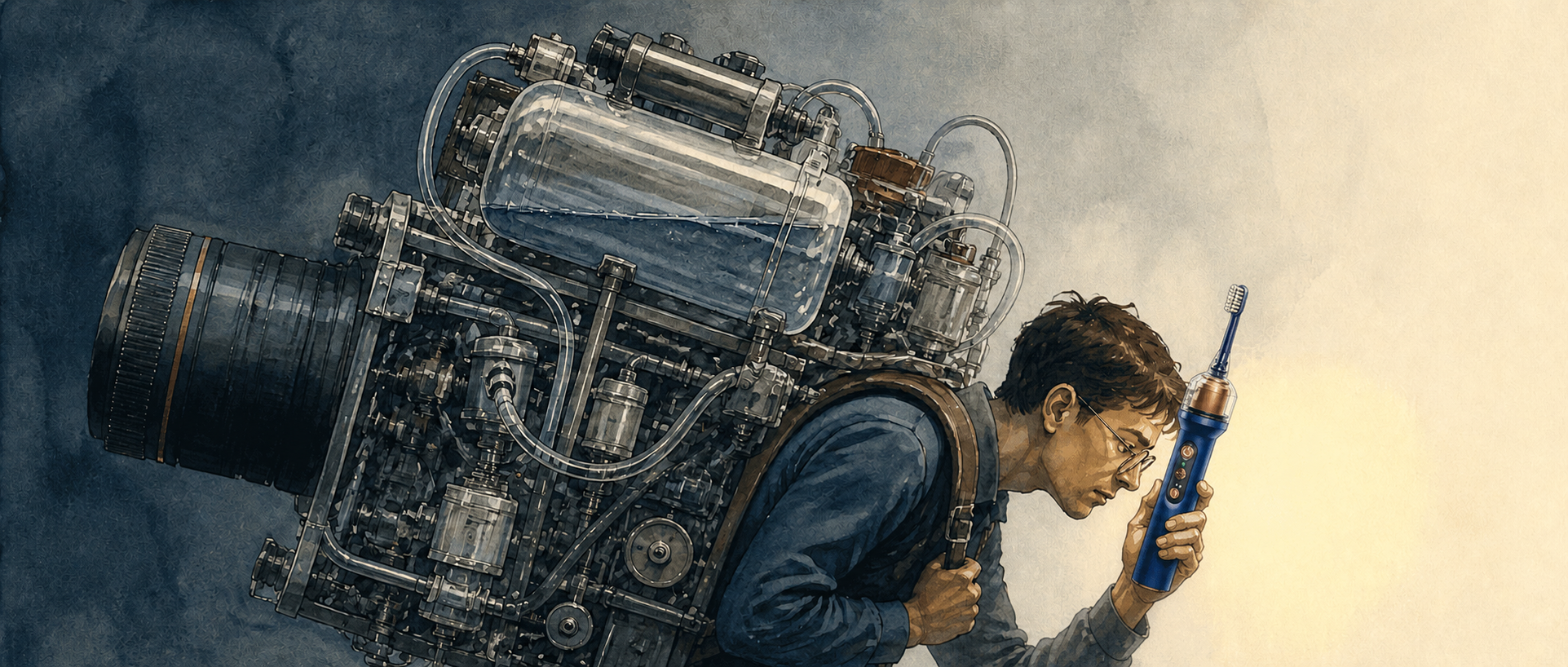
But does cutting out one step really remove one hassle?
To spare you the work of picking up a flosser and aiming it between your teeth, Dyson has added a camera, strobe lighting, image recognition, a spray mechanism, a liquid tank, and a refill dock. A normal electric toothbrush needs charging and a new brush head now and then. This one needs topping up, disassembling and washing, draining at the nozzle, and drying. Dyson also recommends low-foam, SLS-free toothpaste and mouthwash so foam does not blind the camera.
There is no need to get lost in questions like whether it can hit the right gap within a hundred milliseconds as you brush back and forth. Independent testers can settle that. Design lets us ask something simpler first: how many new hassles does it create to eliminate one?
Real integration is not two things stuffed into one casing. It leaves you with less total burden than before. This toothbrush may eliminate a separate rinse, but it brings a system you must carry, refill, take apart, wash, and dry. It may even make you change the toothpaste you already like.
It solves a problem. The problem just is not big enough to justify the machine built around it.
Good design hides the hard part
Internal complexity is not a design failure. Some of the simplest products are terrifyingly complicated inside.
An automatic transmission is far more complex than a manual one, but the driver no longer has to work a clutch, watch the revs, and shift all day. A smartphone is crowded with parts, yet it makes a camera, map, wallet, and a pile of separate devices disappear from your pocket.
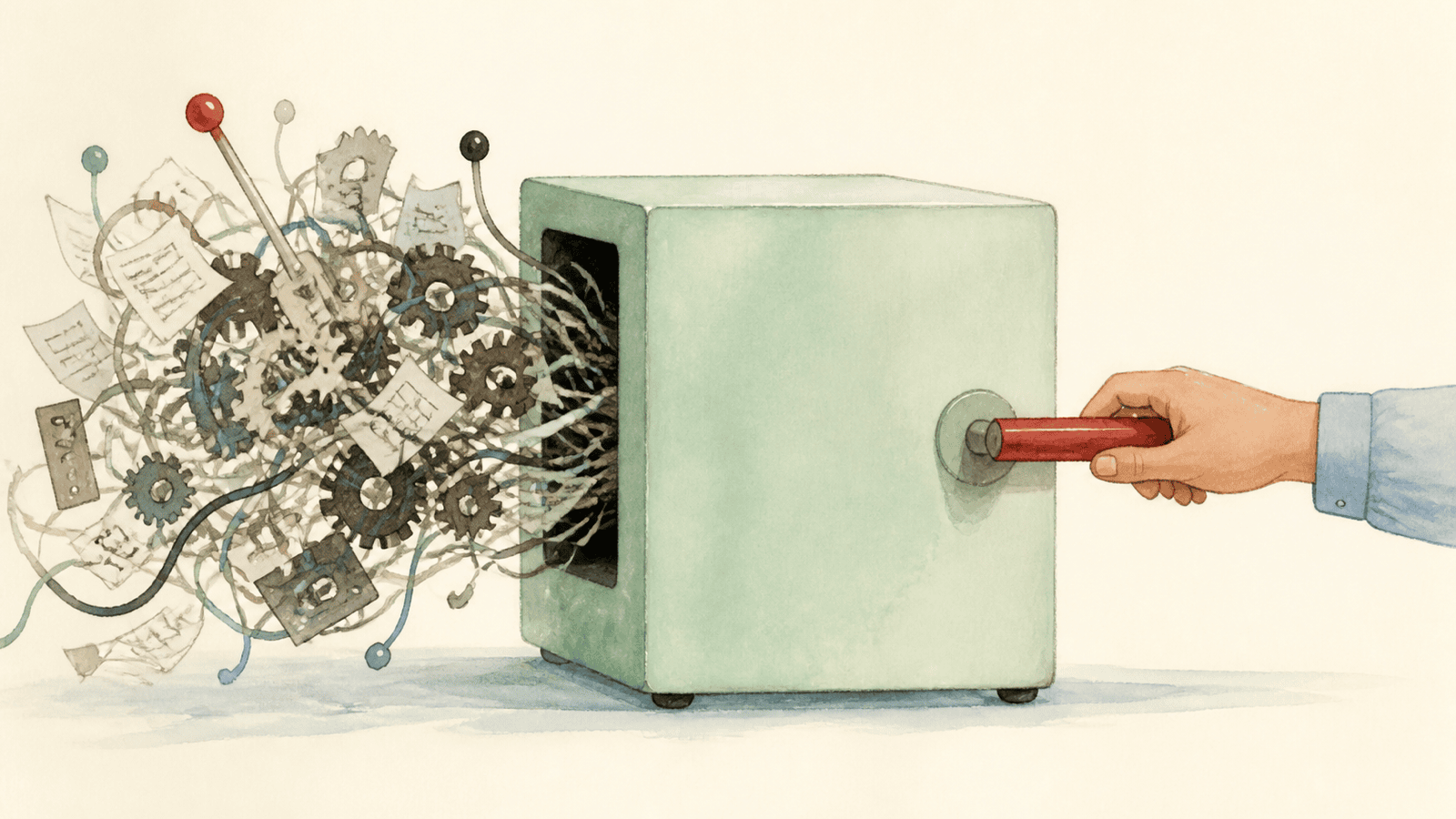
Those products do not destroy complexity. They stop it at the product’s edge. The machine takes the hit; the person gets the clean result.
I like to borrow the word entropy here. Not as a physics lecture, but as a usage bill: how much must a person remember, do, maintain, and worry about? Good design pays down that bill inside the product and hands the user something calm.
The CameraJet does not. Its complexity leaks straight through the interface: into the weight in your hand, the dock on your counter, the ingredients in your toothpaste, instructions for how to brush, and the cleanup afterwards. By that measure, it has raised the entropy.
This is not the Dyson Dyson used to be
The 1993 DC01 was Dyson at its best.
It replaced clog-prone vacuum bags with cyclone separation. James Dyson built 5,127 prototypes to get there. The airflow and filtering inside were anything but simple. But the result for the owner was plain: suction did not quickly fade as a bag clogged, and there were no bags left to keep buying and replacing.
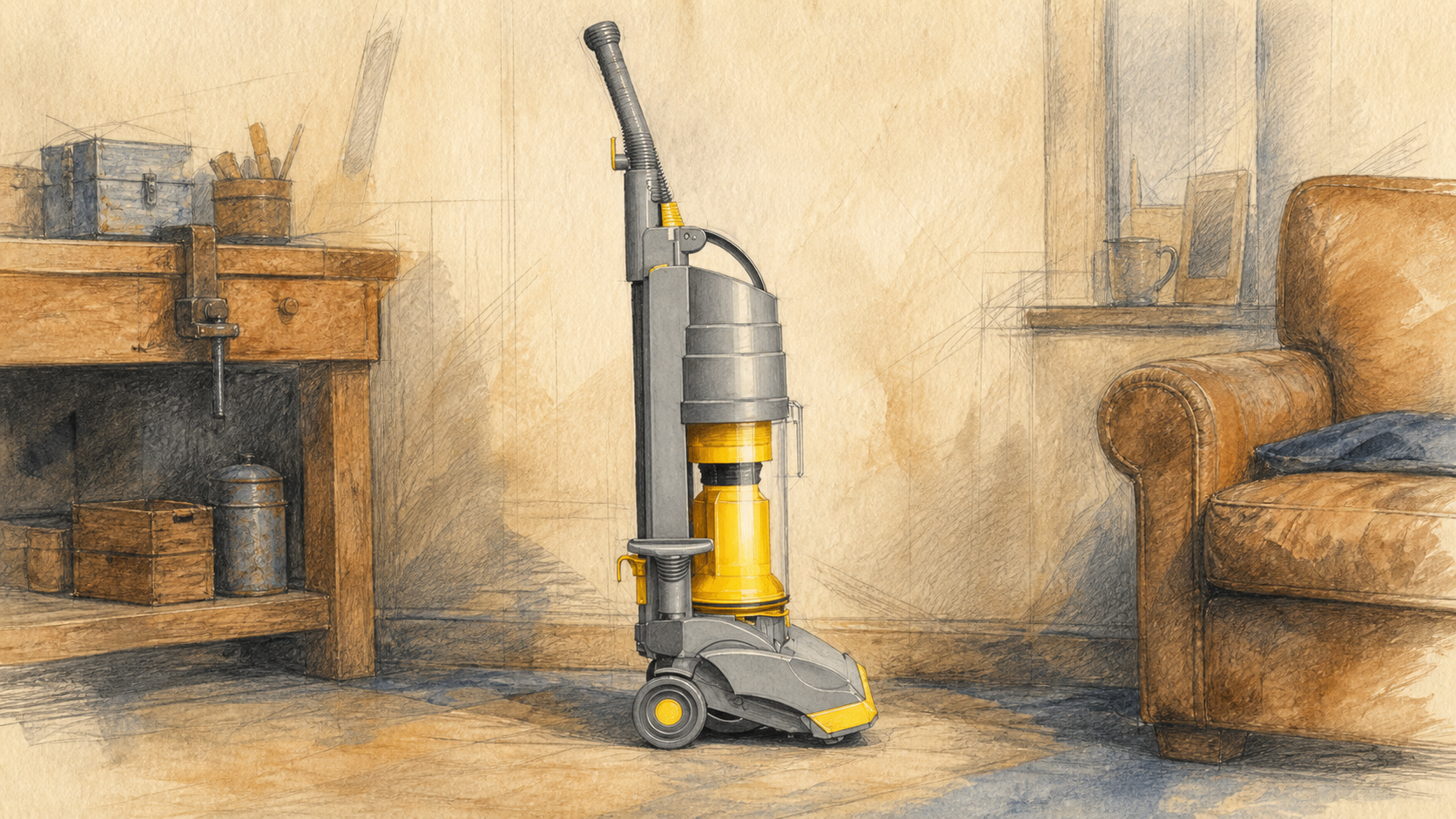
The transparent bin was not a stylist’s first move. With no bag, people needed to see where the dust went. The clear plastic, exposed parts, and mechanical character were simply what that new working principle looked like when it reached the surface. Dyson’s own account of the DC01 puts it plainly: it looked entirely different because it worked entirely differently.
The order of cause and effect matters.
First came the clogged bag and fading suction. Then came cyclone separation. Then the machine took on that form. The problem led to the engineering; the engineering led to the look. Dyson’s industrial aesthetic was a style produced by how its products worked.
A style that succeeds for long enough can get mistaken for the method that made it succeed.
When the style starts driving the engineering
The reservoir ring on this toothbrush does have a job: it holds liquid. But it is also a loud structural announcement. You can see at once that this is not an ordinary toothbrush. There is fluid engineering inside, and it would like to be admired.
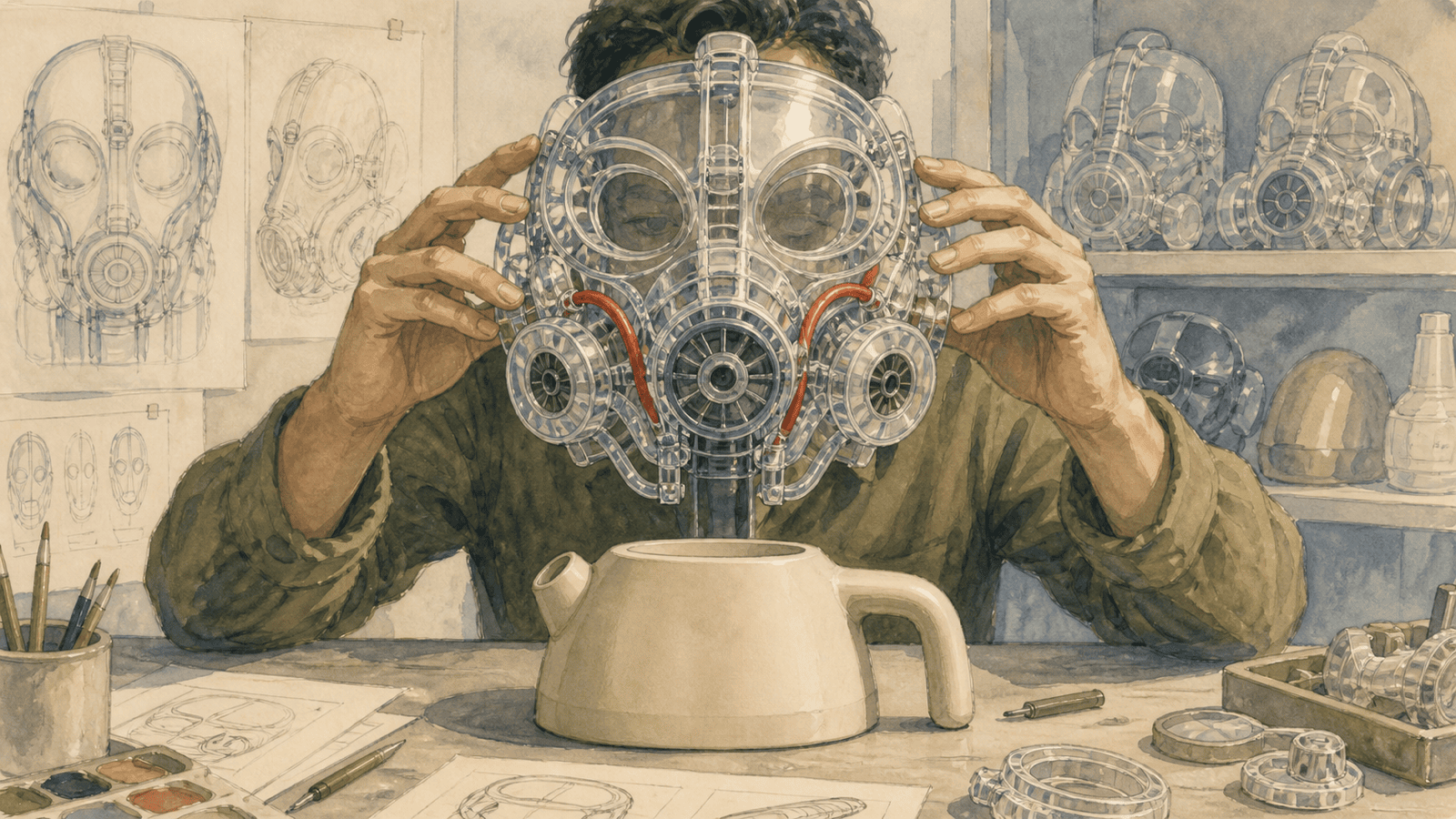
The camera does more than spot gaps. It can stream your mouth to a phone. The app does more than control the spray. It offers cleaning maps, technique guidance, and habit data. The product is not just working. It is continually explaining how much work it is doing.
The now-discontinued Dyson Zone had already shown where this line of thinking leads. It strapped noise-cancelling headphones to a wearable air purifier: filters and tiny pumps in the earcups, a visor floating before your mouth and nose, filtered air delivered to your face.
Noise pollution is real. Air pollution is real. Joining two real needs does not automatically produce a good product. What the buyer got was headphones weighing close to 600 grams, or about 670 grams with the visor fitted, plus filters to replace, a visor to wash, and a small air-treatment machine to wear outdoors. Dyson spent six years developing it. Roughly two years after launch, it was discontinued.
The Zone and this toothbrush share the same reversal: Dyson’s engineering capabilities now seem to go looking for products to inhabit. The company takes what it knows about airflow, filtration, and fluid control into a new setting, then works hard to prove why all of it belongs there at once.
Its older products generated Dyson’s visual language. Its newer ones increasingly manufacture industrial complexity to preserve it. A product that ought to make life quieter turns into an exhibit of everything going on inside.
A great industrial style becomes a product mask
This does not have to mean Dyson has run out of ideas. The likelier explanation may be worse: it became too successful.
Transparency, exposed mechanisms, motors, fluid structures. These are no longer traces left by a few products. They are some of the brand’s most valuable visual assets. A new device must solve a problem, but it has another assignment too: from thirty metres away, everyone should know it is a Dyson.
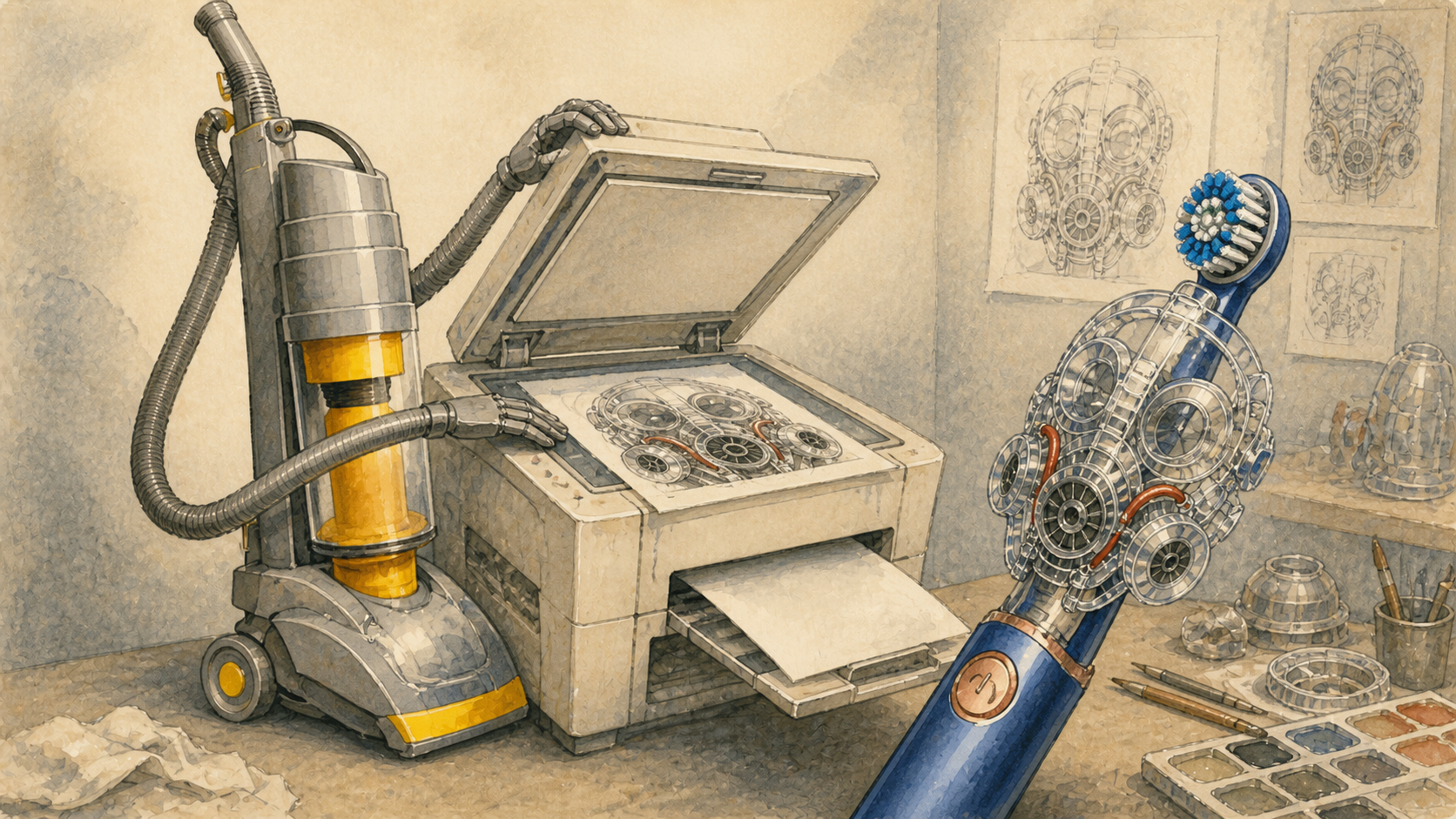
Once a design language becomes a requirement rather than a result, the product starts bending around a preferred look. The old sequence was a worthwhile problem, new engineering, then a Dyson-shaped object. The new one risks becoming: first decide what a Dyson product should look like, then pack needs and functions into that outline.
That creates an oddly comic outcome: Dyson starts knocking off the Dyson of the past.
A knockoff copies the shape and misses the spirit. Dyson does not need to copy anyone else. It already owns a ready-made shape: clear plastic, airflow, motors, rings, and internal workings complicated enough to display. It is beginning to copy that shape while losing sight of the spirit.
The form left behind by success is not the method that created success. The DC01 method began with a specific problem, then used engineering to hide the complexity. Its transparent bin was only the face that method left behind.
Dyson is no longer reproducing the chain of cause and effect behind its old products. It has mistaken the result of success for the method, and the visible signs of success for its substance.
That may be why this toothbrush looks so Dyson. It may also be its biggest problem.
$499.99 is the bill complexity sends later
It is easy to dismiss a $499.99 toothbrush as an absurdly expensive gimmick. But price does not prove a design right or wrong. What this number does reveal is the scale of the system behind the price tag.
To make one toothbrush brush, rinse, identify, spray, teach, livestream, and perform the brand, somebody has to pay for the camera, algorithms, nozzle, tank, dock, and maintenance routine. $499.99 is not the argument. It is the bill complexity eventually sends the customer.
Independent testing will tell us whether the CameraJet actually cleans between teeth better. Real life will tell us whether people enjoy using it. But the design problem is already obvious: it has not used a small system to solve a large annoyance. It has built a large system to argue that a small annoyance deserves one.
Dyson once excelled at doing a great deal inside a machine, then giving the owner one simple outcome. Now it seems increasingly reluctant to hide the engineering. It wants everyone to see it, understand it, marvel at it, and pay for it.
The worrying part is not that Dyson made a strange toothbrush. It is that Dyson is clumsily imitating the company it once genuinely was.