Google I/O dragged the same fight back onto the stage. AI is replacing designers. Again.
The headline act is Pics — an AI design app stitched into Google’s office suite. A regular employee, a small-business owner, a product manager types one sentence and out comes a poster, a slide, a social tile. Paired with Gemini Spark, the always-on agent Google announced the same day, the script writes itself: designing something no longer requires you to open a tool at all.
Then the usual fight breaks out. One side shouts that designers are finished. The other side shouts that AI will never produce work with taste.
Both sides are missing the point.
The gods who stand behind the AI

Ten years ago, a cartoon went around design Twitter: a designer hunched at a screen, with a ring of “gods” standing behind, each barking different advice.
- The boss: “Make it bolder.”
- Marketing: “Make the logo bigger.”
- The PM: “Make the color warmer.”
- The engineer: “Can’t be built.”
- The client’s spouse, leaning in: “I think green would be better.”
The designer revises until they question their existence.
That cartoon needs an update.
New version: the same ring of gods, but now they’re standing behind an AI. Same notes — bolder, warmer, bigger logo — yelled at a different target.
The designer has been edited out of the frame.
Which surfaces a deeply awkward question:
Does this crowd actually produce good design once they’re driving the AI?
For years they directed real designers and the output was mediocre — every piece a compromise between five conflicting demands.
Swap the designer for an AI and suddenly they have taste? Suddenly their direction yields great work?
Of course not. The only thing that changes is the blame. It used to fall on the designer. Now it falls on the AI.
The story hasn’t changed. Only the lead actor has.
The fallacy: I have the tool, therefore I have the skill
A lazy thought has been spreading:
“AI can make images, so I can do design now.”
It’s the same shape as another familiar line — “That photographer is great because his camera is great. Good lens, good shutter, good aperture.”
Anyone who’s held a camera knows that’s nonsense. The camera doesn’t make you a photographer. Because the camera won’t decide for you which frame is worth keeping, why this light works, why this composition holds, why you press the shutter at this instant and not the next. All of that lives in the photographer’s head.
Same with design. Pics won’t turn a regular user into a designer. Because Pics won’t decide for them which version is good, what’s off in version two, whether the edit actually improved anything.
Ten years pass and humans keep tripping over the same rock. Yesterday the gods stood behind the designer. Today they stand behind the AI. The same mistakes are still going to be made. The stage just changed.
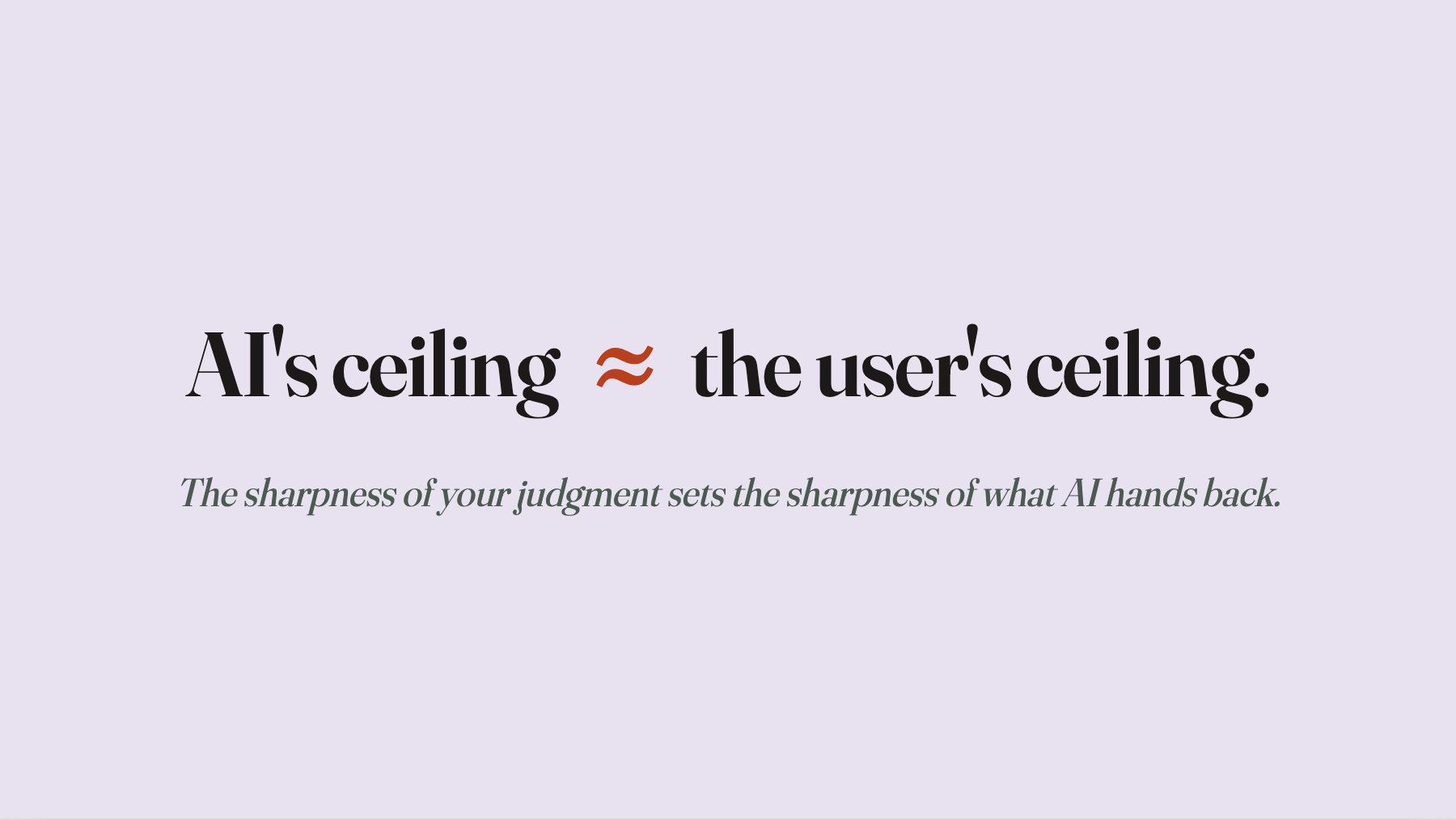
AI’s ceiling is roughly the user’s ceiling.
The sharpness of your judgment sets the sharpness of what AI hands back. Where your judgment is blurry, the AI is blurry in exactly the same place.
So what is the designer actually selling? A right-versus-wrong radar.
The standard answers — creativity, taste, an eye for design, problem-solving — held up fine before Pics shipped, because nobody pushed hard on them.
After Pics, they collapse one by one. AI also claims creativity. AI also claims taste. AI also solves problems.
Not because the AI genuinely has those qualities. It’s that those words were never sharply defined to begin with. What is creativity? What is taste? What’s an eye for design? Anybody can claim to have them. The terms can’t tell humans and tools apart, so they can’t hold up a moat.
Try a different framing: what a designer is selling is a finer right-versus-wrong radar.
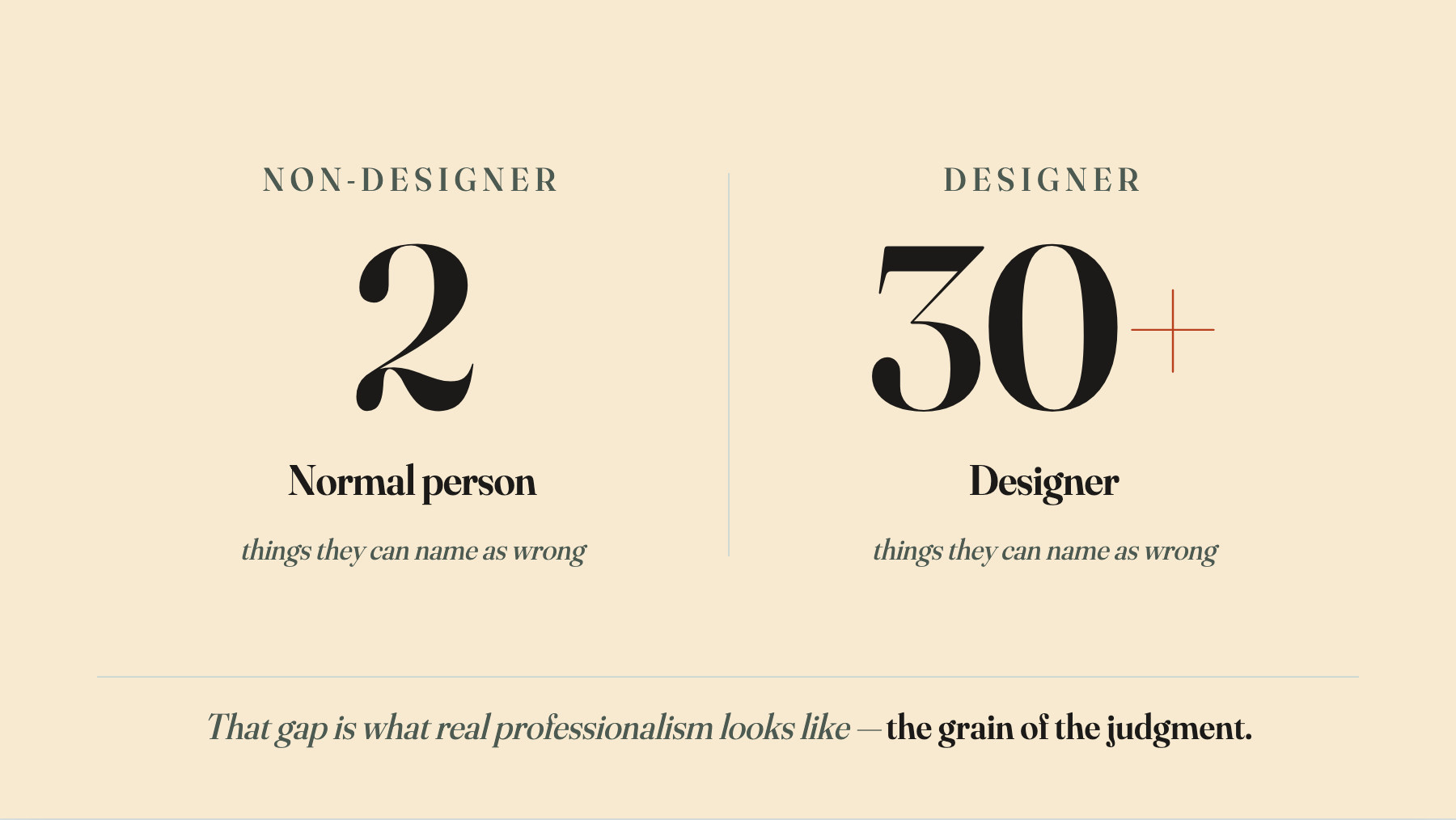
A normal person looks at an image and can say “okay” or “not really.”
A designer looks at the same image and names a dozen specific things that are off: leading is wrong, hierarchy is broken, the button color fights the brand, the type won’t read on a small screen, the negative space is asymmetric, the visual weight leans right.
Show a designer a hundred images and they will rank them consistently against a standard they can’t fully articulate but apply reliably every time.
That gap is what real professionalism looks like. Not creativity. Not taste. It’s the grain of the judgment.
A loss function, run on a human
To explain this properly I need to borrow a term from ML training: the loss function.
You might be wincing already. What does this have to do with design?
A lot. A loss function is what makes AI capable of learning. The human equivalent is what makes a designer capable of growing.
Start with the AI side.
You’re training a model to recognize cats. It looks at a cat image and outputs “80% confident this is a cat.” Ground truth says 100%.
The loss function is the ruler that tells the model how wrong it just was. It produces an error number — say 0.2. The model uses that number to nudge millions of internal parameters. Next time it sees a similar image, it guesses a little closer. After enough cycles, it has learned what a cat looks like.
No loss function, no learning. The model has no way to know whether it just got better or worse.
The crucial part: the precision of the loss function caps the precision of the model. Give the AI a blunt ruler — just “right or wrong” — and you get a blunt model that sorts coarsely. Give it a ruler graded along hundreds of dimensions of error, and you get a finely-tuned model.
A designer’s 20-year arc looks like a training run.
- Ship a draft → mentor says “leading is off” (error computed)
- Designer thinks “leading is leading” (didn’t get it)
- Ship next draft → designer starts looking at leading (parameter adjusted)
- Next round → mentor says “hierarchy is broken” (new error)
- Designer thinks “what hierarchy?” (still didn’t get it)
- Next round again → designer starts looking at hierarchy
A few thousand cycles in, the ruler in their head has gone from a two-notch “okay / not okay” to something graded along hundreds of axes.
Only what gets adjusted isn’t code. It’s intuition — the weights on certain neurons. The thing people mean when they say “I can just tell.”
I call this a loss function, run on a human.
Most people have never been through this training loop, so the ruler in their head only has the rough notches.
Three consequences that fall out of this
One. AI takes the making. What’s left is judgment.
Watch a Pics session: regular user writes a prompt, AI returns three versions, user clicks an element, leaves a note saying “warmer,” AI iterates.
Making — every action that puts pixels on the canvas — is now the AI’s job.
What’s left for the user is pure judgment: Which version is better? What’s off about it? Which direction should the next pass go? Did the edit actually improve anything?
That happens to be what designers have been doing for 20 years. AI automated execution. But picking the direction and grading the result? AI can’t do that for you. Because both require knowing what good actually looks like.
Worse: AI doesn’t just refuse to judge for you. It will never doubt your judgment either.
You say make A. It makes A. Faster and more obediently than any human designer. It won’t stop and ask: “Are you sure you want A? Are you sure you don’t really want B?”
A designer who pushes back on the brief is something AI can’t replace. A designer who only nods and ships? AI is cheaper.
Two. Your blunt ruler means AI’s output is blunt too
Back to: AI’s ceiling is the user’s ceiling.
The Google demo of Pics looks dazzling — because the person writing the prompts is a Google designer, and the person giving feedback is a Google designer. Put a regular user in front of the same tool and you get a pile of work that looks AI-made, technically fine, and impossible to actually use.
The tool isn’t broken. The ruler in the user’s head is too blunt. They don’t know what’s off, so they don’t know what to change, so the AI stops at the same blunt level.
Three. This ruler only grows under pressure
If a regular user spends thousands of hours in Pics, does their radar sharpen automatically?
A little. Not to a designer’s resolution.
The designer’s ruler is built in an anti-human way — it requires you to actively find what’s wrong with images that already look fine. That impulse doesn’t appear on its own. It has to be forced in: a mentor calls out a flaw, a client rejects a draft, you look at your own work from ten years ago and cringe.
A regular user has no such pressure. If the image is good enough to post, it ships.
So will everyone become half a designer?
If Pics shoves the judgment seat in front of every user, do we all end up half-designers in 20 years?
Two layers to this.
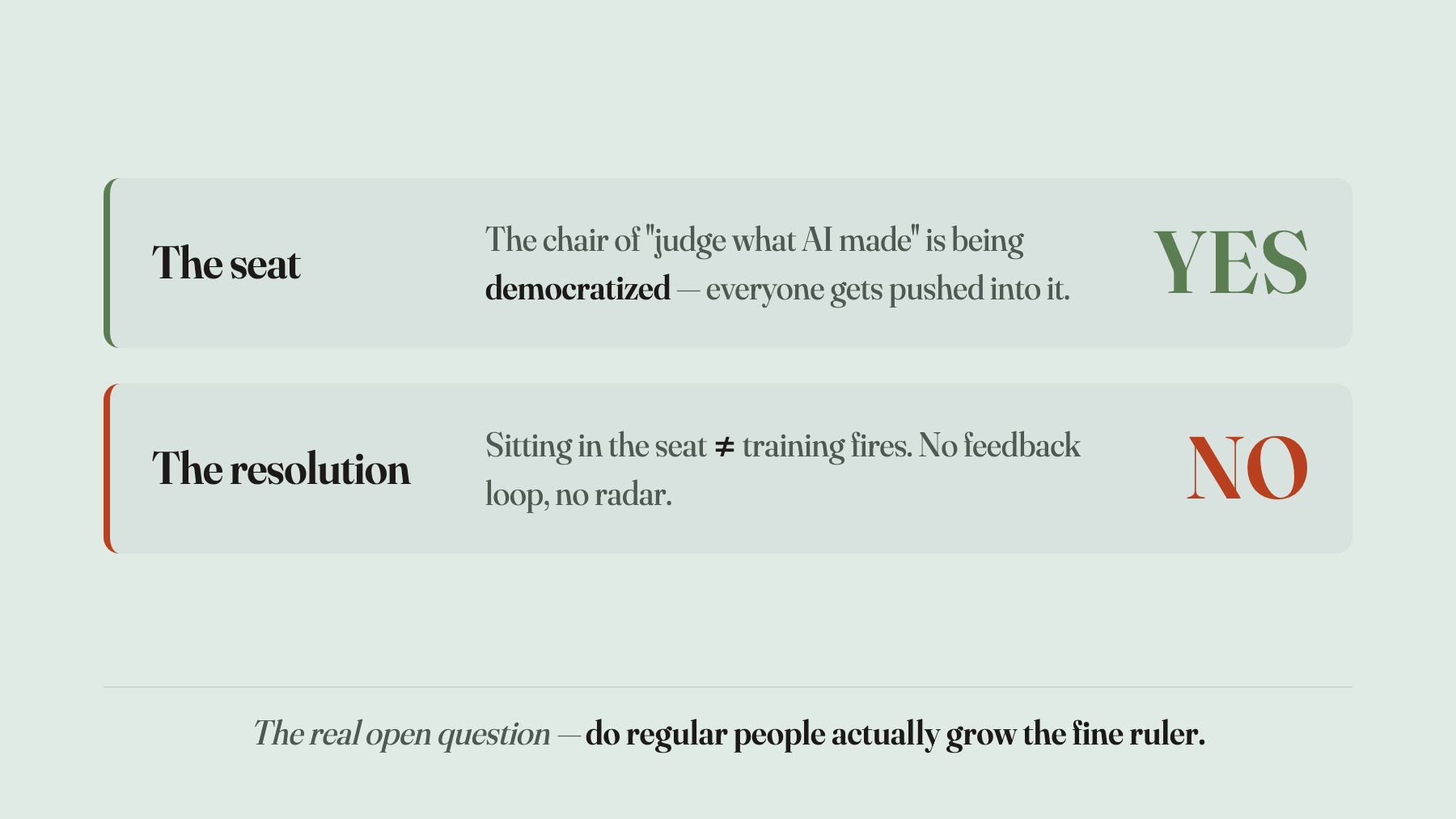
The seat. Yes. The position of “look at what the AI made and decide if it’s good” is being democratized. It used to be the designer’s daily chair. Now product managers, marketers, small-business owners, regular employees are all dragged into that chair by Pics.
The resolution. No. Sitting in the seat doesn’t mean the training loop is running. A regular user generates an image in Pics and probably never does the post-mortem — never asks “what’s actually off here?” If it looks decent, they ship it. Twenty years later, same user, same two-notch ruler. The seat exists. The loss function never fired. The radar never grew.
The real open question isn’t “do designers disappear.” It’s “do regular people actually grow the fine ruler.”
If they do — the moat collapses. If they don’t — designers get pulled in harder wherever quality actually matters, because everyone else is now generating mediocre work at industrial scale and somebody has to gate it.
Which way it goes, Pics won’t tell you. Neither will Google.
The question “is a designer still worth anything” used to have an easy answer: creativity, taste, eye for design, problem-solving.
After Pics, those answers fold one by one — AI claims all of them too.
The version I’d offer: what a designer is selling is a right-versus-wrong radar, ground down by a loss function run on a human — tens of thousands of reps of someone saying this is wrong, that is wrong. Not a gift. Not taste. A residue.
And the gods standing behind the AI never went through that training loop. They couldn’t direct designers to good work back then. They can’t direct an AI to good work now.
AI didn’t change the underlying truth. Pics just put it on the main stage for the first time.