Anthropic shipped Claude Design a few weeks back. Figma dropped a few points the same day. Google’s Stitch from March piled on. Designer Twitter ran the usual “design is dead” cycle.
I sat down and used it.
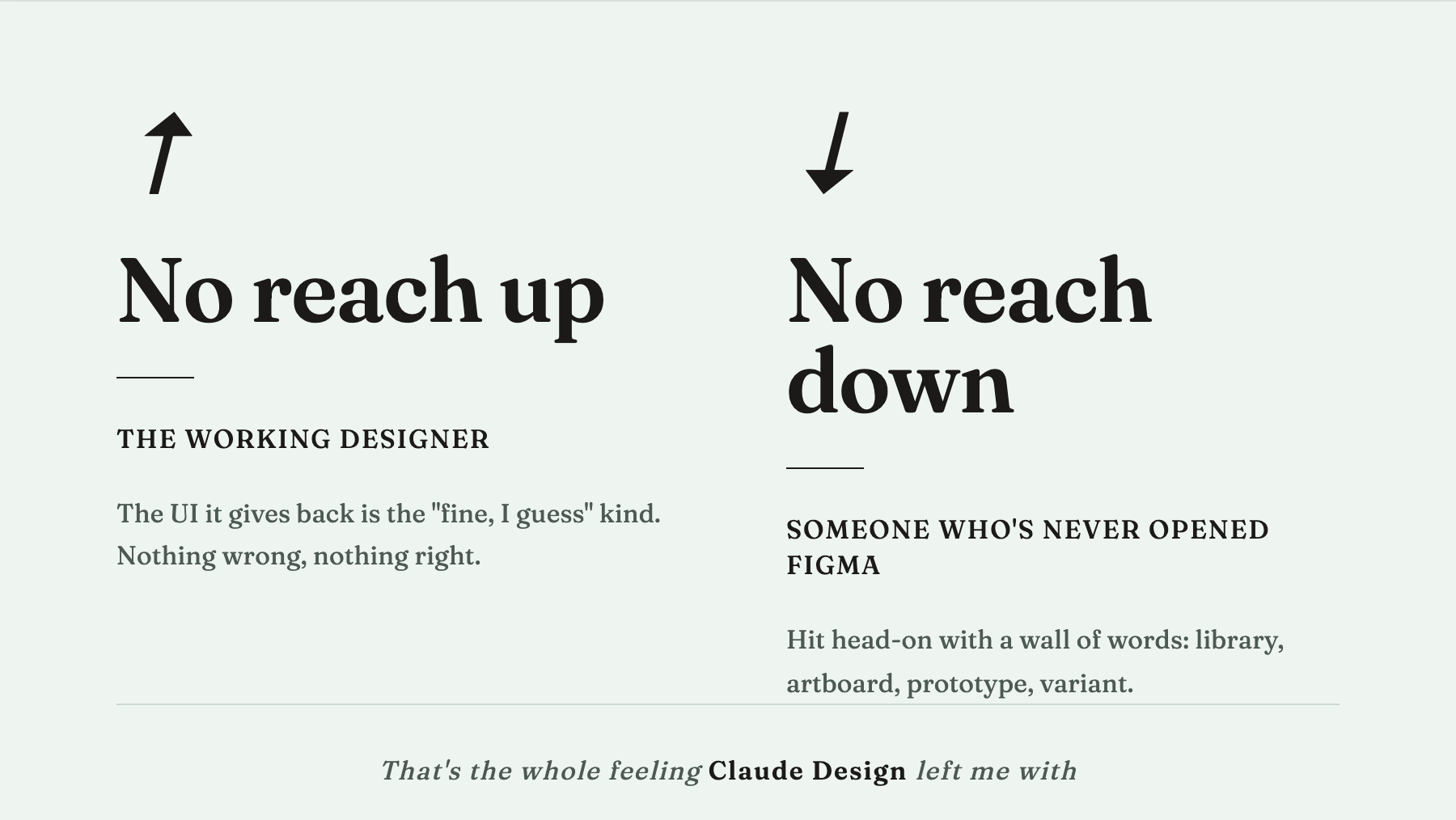
It doesn’t reach up. Hand it to a working designer and the output is fine. Not wrong anywhere, not right anywhere either. The kind of work where you can’t point at a mistake but you also can’t point at a decision.
It doesn’t reach down. Hand it to someone who’s never opened Figma and the first screen throws words at them: library, artboard, prototype.
Claude Design lands in between. That’s an awkward place to land.
Where the mistake is.
The people who built this product made an AI tool that looks like desktop software.
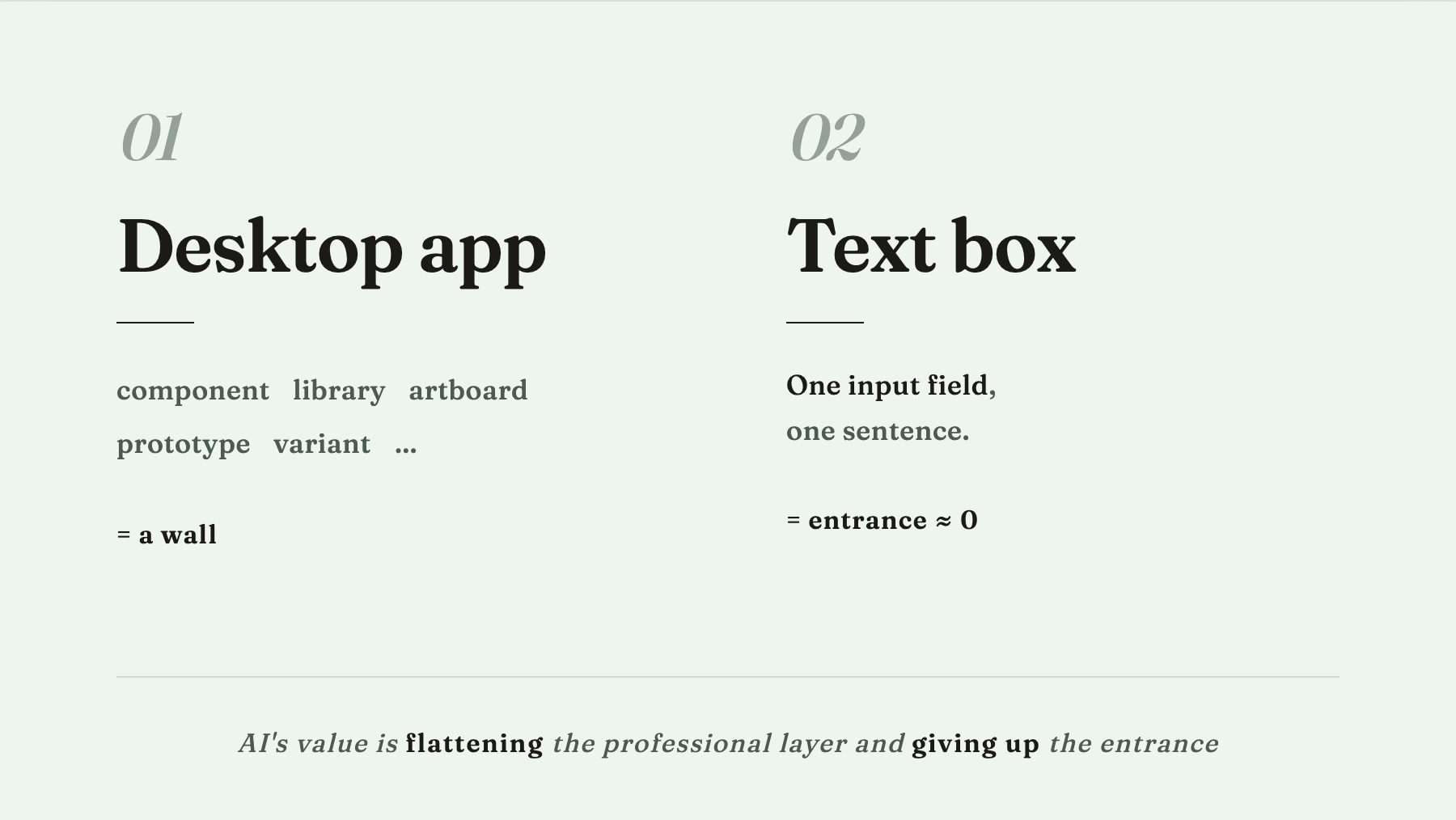
The desktop-software logic is to take everything a Figma user has internalized — component libraries, variants, auto-layout, design tokens, the artboard view — and put it on screen. For Figma users that’s muscle memory. For everyone else it’s a wall.
But that’s not where the value of AI lives. What AI gives everyone is an entrance that’s almost zero. One sentence, one image. That’s the entire pitch.
Anthropic itself already shipped the right version. It’s called Claude Code.
Open Claude Code. No project dashboard. No “professional development workflow” tutorial. Just a text box.
A senior engineer uses it and organizes the workflow themselves — because they know how to write specs, how to debug, how to accept work. Claude Code doesn’t think for them. It hands the thinking back.
Someone who’s never written code uses it and doesn’t need to know what “workflow” means. They just chat. Can you build me a webpage? Change that line, let me see it again.
The pro doesn’t need the tool setting rules for them. The amateur doesn’t need the tool teaching them rules. Neither group wants a “correct workflow” wedged into the middle.
Claude Design wedged one in anyway.
Will AI replace designers?
Yes. One kind.
The kind whose work is the tool itself — the pixel-pushers, the people whose job is just operating the software. Every tool transition clears that group out. Nothing new there.
There’s another kind of designer whose work isn’t in the tool at all.
A client comes in with a fuzzy idea. “We want to make an A.” But inside that idea — what they have, what they’re missing, who it’s for — the client usually can’t tell you. They don’t know.
The designer’s actual job lives here: turning what the client can’t articulate back into something they can. Sometimes what gets built isn’t an A at all. It’s something else, and it turned out to be what they actually wanted.
AI can’t do this step.
Not because AI isn’t smart enough. Because AI doesn’t doubt you.
You say A, it makes A. Faster than you, more diligent than you. It never stops and asks: are you sure you want A?
So the ceiling on any AI tool is the judgment of the person using it.
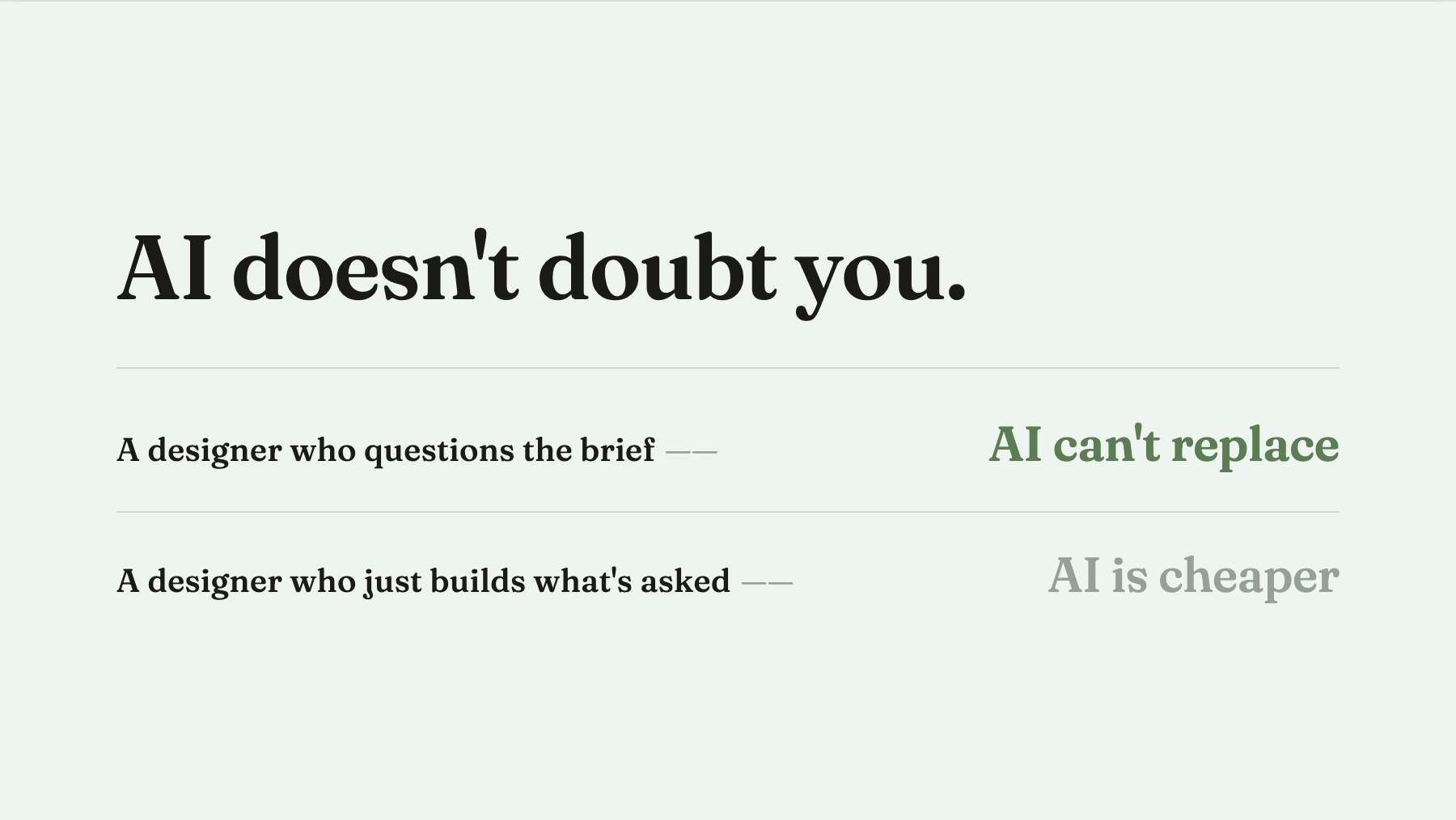
A designer who questions the brief — AI can’t replace. A designer who builds whatever the brief says — AI is cheaper.
Back to Claude Design.
The product’s awkwardness has a clean explanation. The people who built it are themselves in the “builds whatever the brief says” camp. That’s why they piled on a “professional” workflow — to prove they were being professional.
But that’s not where AI’s value sits. AI’s value is flattening the professional layer and opening the entrance to everyone.
A good AI design tool should look like Claude Code. Chat is the entrance. The pro adds finer grain on their own. The amateur stays at the chat layer. Both get served.
Claude Design walked past the shortest path and ended up in the middle, reaching neither end.
This blog critiques everyone’s design. Today, Anthropic’s turn — the rising star.
Claude Design might not be the win everyone says it is.