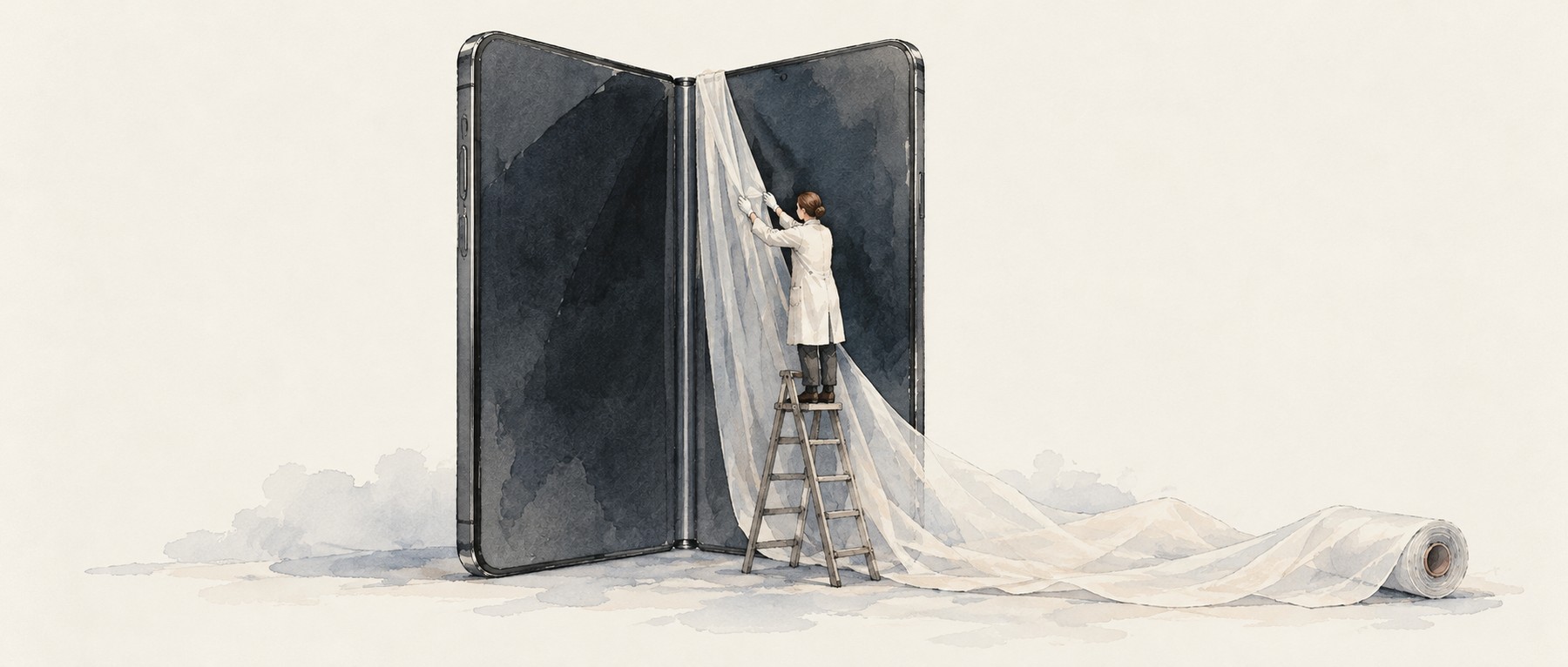
The iPhone Duo is on sale. To nobody’s surprise, the conversation is about the crease.
How flat is the screen when you open it? What’s underneath the matte layer? Does peeling it off make the crease more obvious? Here is an entirely new kind of iPhone, and the thing everyone wants to examine is still that line down the middle.
The crease hasn’t suddenly become more important. The product has given us little else worth talking about.
A compelling product earns forgiveness
Whenever we pick a product apart, we’re making a trade: does what it gives me justify what I have to put up with?
When a product does something we couldn’t do before, or makes an awkward task effortless, its appearance starts to make sense. Odd proportions seem justified. A structure we once found ugly begins to look cool. What it looks like and what it can do become so closely bound together that judging them separately becomes difficult.
Take the recent Roadster. Hardly anyone was discussing the styling. Musk’s Roadster takes design to its limit
That’s how a product’s capabilities change our aesthetic judgment. They do more than persuade us to hold our complaints. They can make a supposed flaw acceptable, even forgettable. When a product is so good you don’t want to put it down, point out that it could be thinner, its corners could be rounder, or it has a crease down the middle, and the answer is: “So what?”
When a new product gives us no compelling reason to use it, the scrutiny shifts to its looks. We compare proportions, inspect seams, and judge the finish. There isn’t much else to discuss.
A product that can’t make its own case has to hope every detail is beyond reproach.

That’s how screen flatness became the main event.
A line down the middle doesn’t stop you reading your feed, answering messages, or watching a video. A slight dip doesn’t stop your fingers typing. Absolute flatness makes almost no practical difference to these everyday tasks. Yet people will keep adjusting the light and viewing angle to establish exactly how visible the crease is.
If the Duo offered something a conventional phone couldn’t, something you would struggle to give up once you’d tried it, we would be talking about what it lets us do. The crease would be a minor concession made in exchange for that ability. Instead, it has become the star of the launch.
The argument over flatness doesn’t mean our taste has become fussier. It means the product hasn’t earned a more interesting conversation.
Excellent engineering doesn’t guarantee a good product
Foldable phones encourage an easy mistake: the more technical problems we solve, the more valuable the product must become.
Start with software. Foldable development guides describe phones closed, fully open, half open like a book, and half open like a laptop. Add portrait and landscape orientations, then split-screen windows. Someone has to decide how the app rearranges itself, where the buttons go, and how you resume a task after moving to the other screen. A few more designers lose a little more hair.
The hardware is no simpler. A screen that once stayed flat must now bend repeatedly. A rigid body acquires a hinge. Will the display survive the folding? Will the hinge stay firm? Will the two halves meet neatly when closed? Each question requires serious engineering.
None of these problems is easy. But once the software adaptations and hardware fixes are done, what has the user gained? Most of that effort repairs disadvantages introduced by making the phone fold. It doesn’t create a new benefit.
Good design takes trouble off the user’s hands. An automatic transmission is complicated inside, but it relieves the driver of working the clutch, watching the revs, and constantly changing gears. The work the driver no longer has to do justifies the complexity.
Much of a foldable’s complexity, by contrast, exists to make the folding arrangement work. Hinges and flexible displays have real technical limits. But “this phone must fold” was a choice the designers made first. Once that choice is settled, the engineering goals are obvious: thinner, firmer, flatter. Getting absorbed in those goals makes it easy to forget what folding was supposed to improve in the first place.
Solving problems you created isn’t the same as solving your users’ problems.
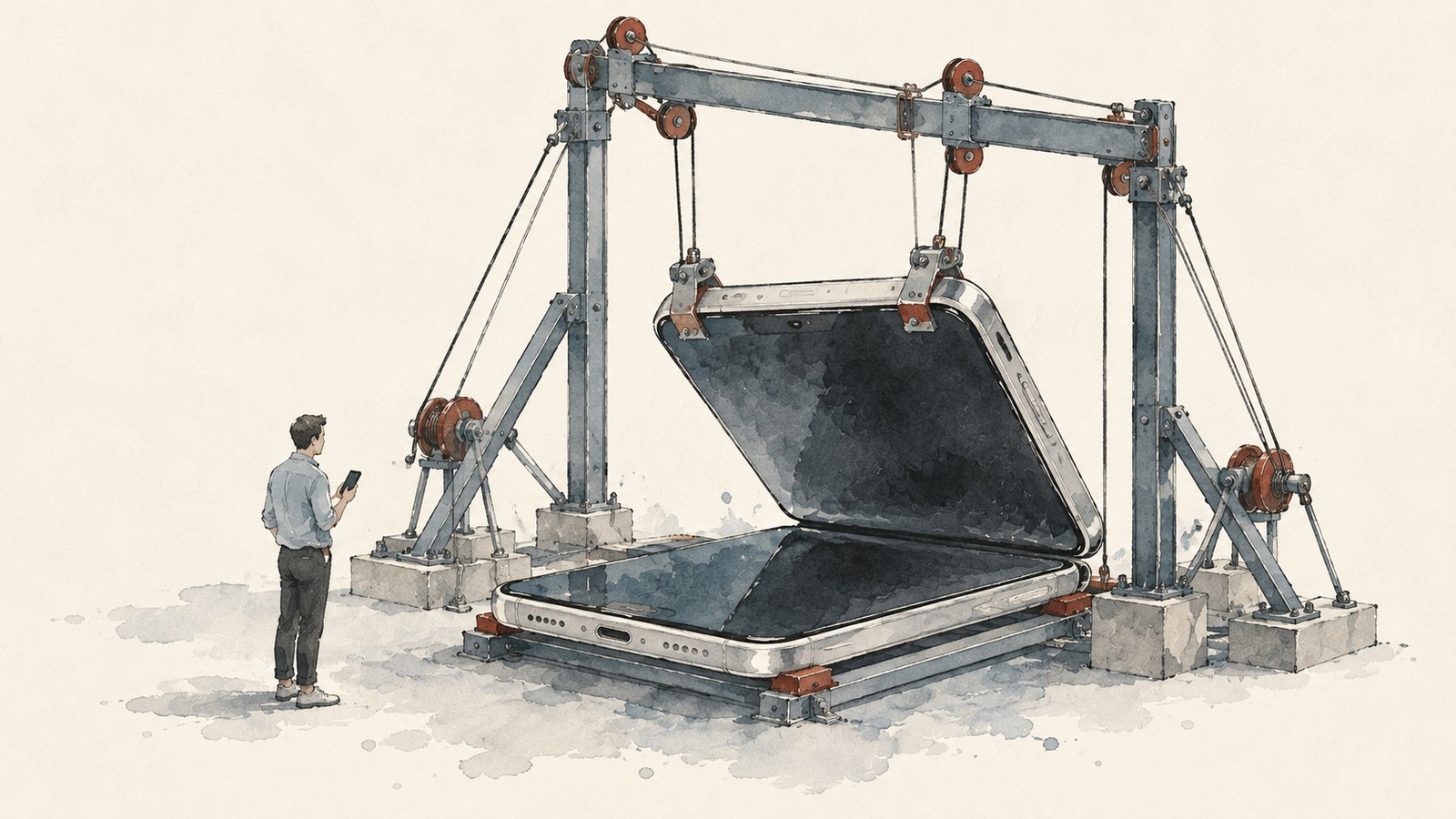
Imagine all that engineering perfected. The crease disappears. The hinge never loosens. Apps move seamlessly between every possible position. I would still ask: what does this phone give me beyond the ability to fold it? If the answer is a bigger screen, a wider keyboard, and room for two apps side by side, an enormous effort has left us doing the same things we already did.
Someone sends me an address. I still have to find it and open the map. Someone proposes a meeting. I still have to move the time into my calendar. Two windows reduce the switching, but transferring information remains my job. The next step worth anticipating is a machine that takes over that work. Apple’s foldable story is still about giving me more room to perform it myself.
Before praising the iPhone Duo, consider what it asks us to keep doing
Making a design work reliably and making it worthy of a new product line are different achievements. Even if Apple fixes every drawback of folding, it still owes us a reason to choose it.
Does Apple still remember “less is more”?
The matte layer makes this cycle particularly easy to see.
The nano-textured layer on the Duo’s inner display cuts reflections and makes the crease less conspicuous. The teardown comparison is clear: peel it away, and the surface underneath is glossier, with a more visible crease.
First, add a mechanism so the phone can fold. Folding leaves a crease, so add another layer to make it harder to see. One design decision creates the next assignment; the next decision tidies up the evidence of the first. As the additions accumulate, does Apple still remember what “less is more” means?
This is design caught up in fixing its own consequences. It’s easy to mistake for innovation because every step requires real technical skill. What’s harder to explain is how much better any of it makes someone’s life.
The engineers keep solving problems. The product doesn’t deliver a corresponding benefit.
Apple has used visual persuasion before. The MacBook Air’s wedge put its thinnest edge right in front of you. You could see how light and thin it was at a glance. That gesture amplified an established benefit: a computer you could carry around with ease. You wanted the product first, then admired how its shape expressed that portability.
The Duo’s extra layer is busy concealing a flaw. Folding hasn’t yet delivered an experience good enough to make us forget the crease, but design has already taken on the job of making the crease harder to notice.
The Air made its advantage more obvious. The Duo works to make its disadvantage less so.
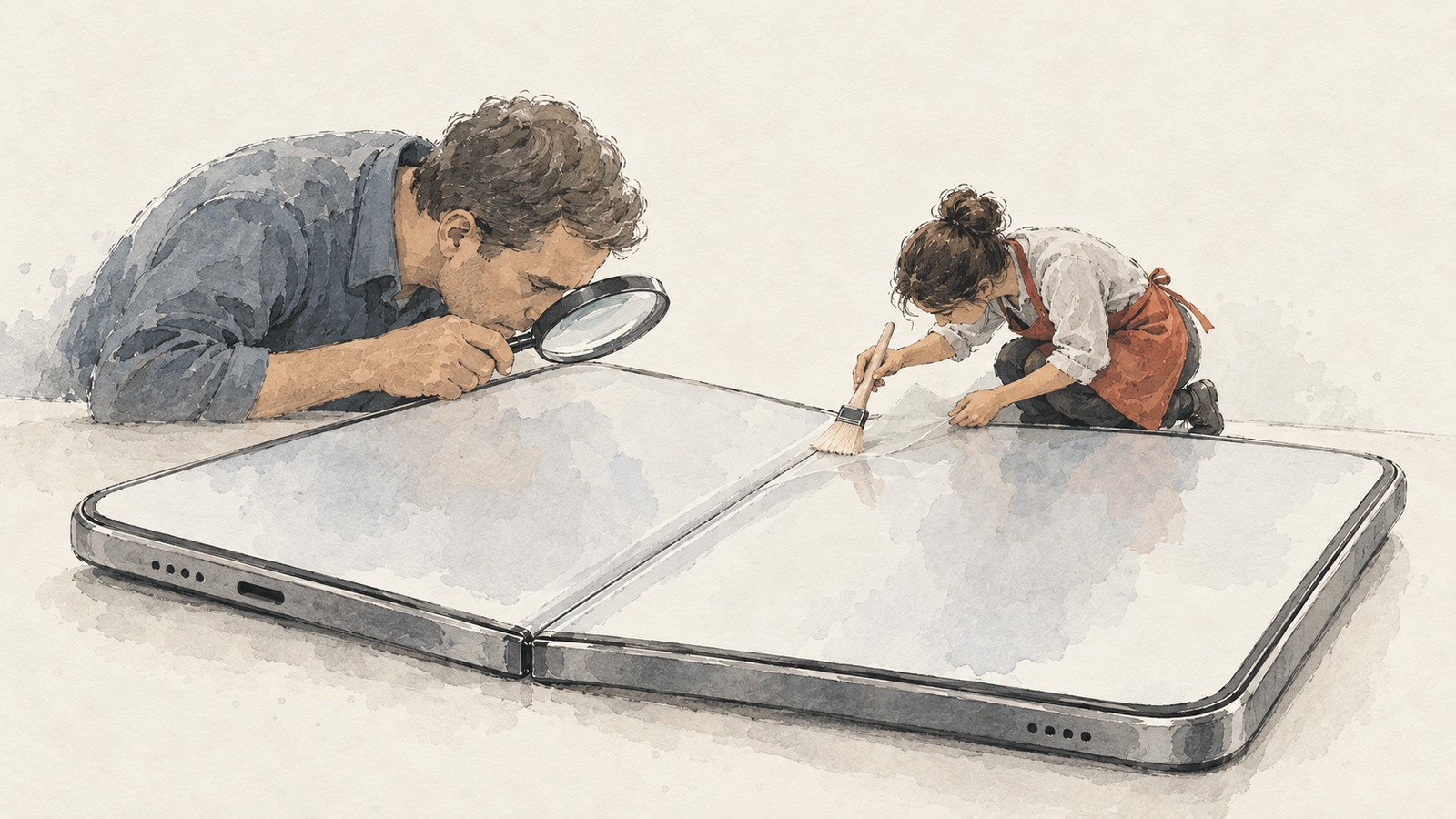
The irony is that every additional effort manufacturers devote to flatness reinforces the idea that flatness deserves all this attention. Users inspect the crease. Manufacturers work to hide it. Both keep circling a question of remarkably little consequence. Quite a spectacle.
Being able to build it isn’t a reason to build it
What has disappointed me about Apple in recent years is precisely how seriously it pursues this work. Greater technical ability makes it easier to turn a questionable choice into an endless series of solvable problems. A difficulty appears, so add technology. If the technology isn’t ready, wait for the next generation. There is always more work to do. Whether the work itself is worthwhile becomes a less pressing question.
That is what makes this kind of design so hard to stop. Every problem solved supplies another reason to continue. We’ve come this far. The next version will be better. Walking away starts to feel like repudiating everything already achieved. Gradually, the reason for doing the work becomes how much work has already been done.
This is where design judgment matters. Someone has to be able to stop a technically improving proposal and acknowledge that its improvements still don’t justify the product’s existence. Without that judgment, all that remains is to keep refining something that serves little purpose.
Apple should have stayed out of this. Not building something because you can’t is a limitation. Being able to build it and choosing not to is judgment.