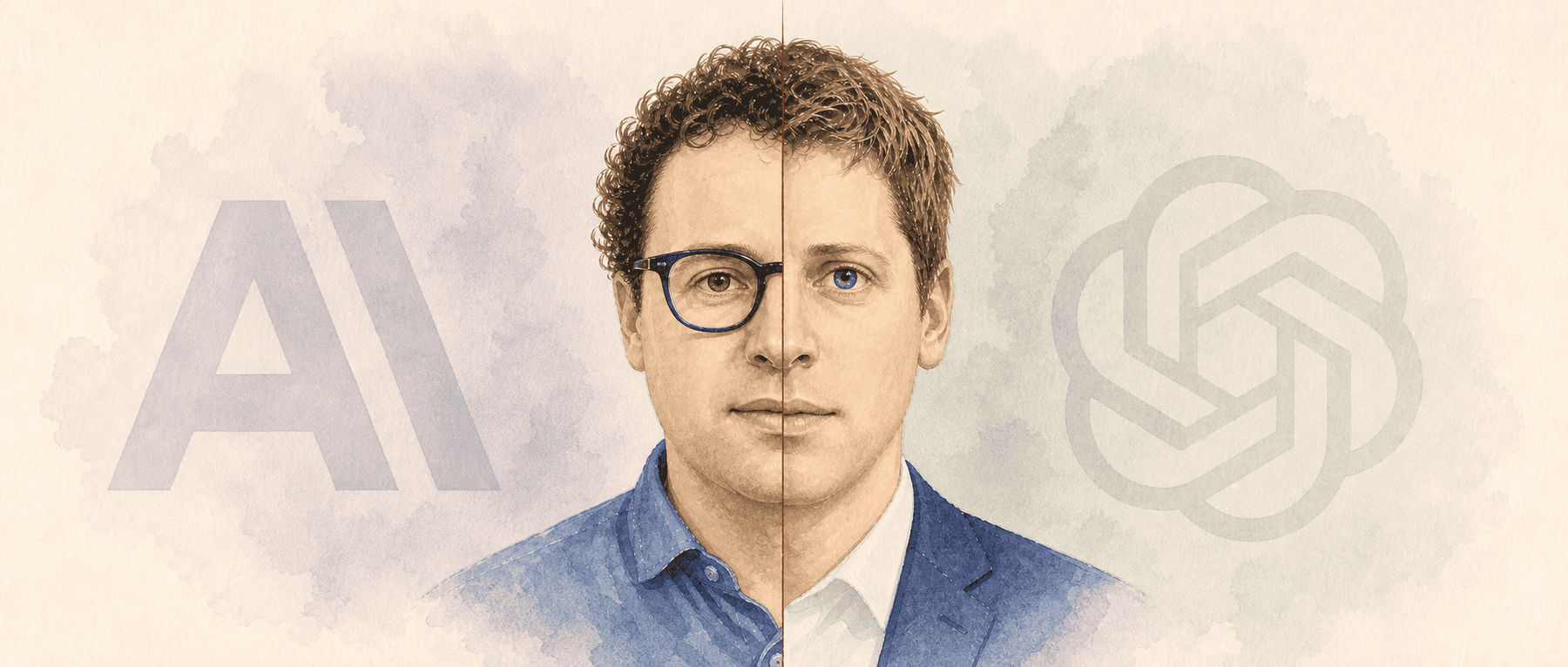
If AI were just software, a company’s character wouldn’t matter much.
An arrogant browser you replace. A greedy social app you delete. But Anthropic and OpenAI aren’t trying to build software. They’re building AGI — something that understands a problem, forms a judgment, and eventually acts on your behalf.
That changes what a company’s character is worth.
How these two read their users right now, how they read the world, how they handle the pull between safety, money and the state: all of it can end up inside the model, as part of the intelligence itself.
So when I say Anthropic is arrogant and OpenAI is greedy, I’m not grading two founders. I want to know which version of itself each company is putting into the thing that comes after them.
Anthropic’s arrogance is easiest to see from outside English
Claude still has no official Chinese interface.
English, Japanese, Korean, Indonesian, a stack of European languages — no Chinese. What makes it stranger is that Anthropic runs a Chinese help center, and Claude will answer you in Chinese if you write to it in Chinese. The company knows those users exist and is obviously capable of serving them. It has simply never treated Chinese as a language worth serving properly.
Anyone who works in Chinese every day feels the difference inside a week.
Claude writes perfectly correct characters. But in long-form work, in tone, in anything that depends on how Chinese actually carries meaning, the answer reads like it was thought through in English and then moved over. Every word is a real word. Every sentence parses. None of it sounds like someone who lives in the language.
For an ordinary app, a missing locale is just unfinished localization. Claude claims to be building general intelligence. So the question stops being how many buttons got translated and becomes: general for whom?
Mainland China isn’t in Claude’s list of supported regions, and Anthropic publicly bars Chinese companies from its services. It’s entitled to make those commercial and security calls. But Chinese isn’t a jurisdiction, and it certainly isn’t a political system. People think, write and live in Chinese in Vancouver, Singapore, Kuala Lumpur, London.
A company can decide not to enter a market. It shouldn’t shove an entire language to the edge of what the machine takes seriously on the way out.
I can’t prove Anthropic deliberately thinned out Chinese in training. Nobody outside the company can see the data mix. What users can see is the result: the Chinese experience is plainly worse than the English one, and years in, that has never become a problem the company had to fix.
Which is the dangerous part. Anthropic’s judgment about China no longer lives only in policy pages and blog posts. It has started to shape what the model learns properly, what it can say well, and who gets the complete version of it.
If you read and write in English, none of this is visible from where you sit — which is exactly why it’s worth saying out loud. Every model carries values; neutrality was never on offer. But a foundation model sold to the whole world shouldn’t quietly turn one company’s private political read into a ceiling on what everyone else can do with it. Swap in any language whose speakers an American company finds strategically awkward and the shape of the problem is identical.
The same posture shows up in how Anthropic trained Claude in the first place. It bought print books by the truckload, cut the spines off, scanned them page by page, and pulped what was left. A court found that training on legally purchased books this way counts as fair use. The picture still tells you something. Once the text is inside the model, whether the book survives as an object stops being interesting. When the goal is assumed to be right, everything outside the goal turns into a cost you’re allowed to ignore.
That isn’t evidence about Chinese. It just stops the language decision from looking like a routine localization oversight. Anthropic’s arrogance sits right here: it believes it has the right to choose who it serves, and past that, the right to choose who a general intelligence needs to bother understanding.

OpenAI’s greed isn’t money. It’s the refusal to choose.
OpenAI took the other road.
In the past couple of years it turned Sora into a video social app, shipped the Atlas browser, released Operator and a visual workflow tool. Each one arrived looking like the front door to the next era. Some were folded into something else within six months. Some were switched off before their first birthday.
Killing a failed product is fine. Experiments are supposed to be allowed to fail.
But running an experiment and announcing that the future has already arrived are two different activities.
An experiment says: I don’t know whether this works, so here’s a product, let’s find out. It didn’t work, we shut it down, done.
A story told to investors runs the other way around. First you say video will change how things get made, browsers will be the way into AI, agents will rewrite all software. Then you ship the product as proof that OpenAI is already standing in each of those futures.
Once that’s the job, whether the product lives barely matters. If the launch convinces the market that OpenAI hasn’t missed the next front door, most of the work is already finished.
Why does it have to keep doing this? Because of how much money it needs.
Training runs, chips, data centers: every line item is enormous. Microsoft holds roughly 27 percent of OpenAI, and OpenAI has committed to $250 billion in future Azure purchases. Its cloud deal with CoreWeave expanded at one point to as much as $22.4 billion.
Those numbers don’t prove any particular product was built for the capital markets. They do explain why OpenAI has to keep telling a bigger story. Nobody underwrites that on the strength of a chat app. They have to believe almost all future software, content and services will route through OpenAI.
So the company can’t just do one thing well. Anything that might turn out to be the future needs a flag in it first.
That’s what I mean by greed. Not that it wants money, not that it ships too much. It won’t choose. Video might be the future, so it takes video. Browsers might be, so it takes browsers. Agents might be, so it takes agents. Whichever way the future turns, capital has to believe it turns through OpenAI.
A product is meant to answer whether anyone actually needs it. These ones are answering something else: can the story keep going?
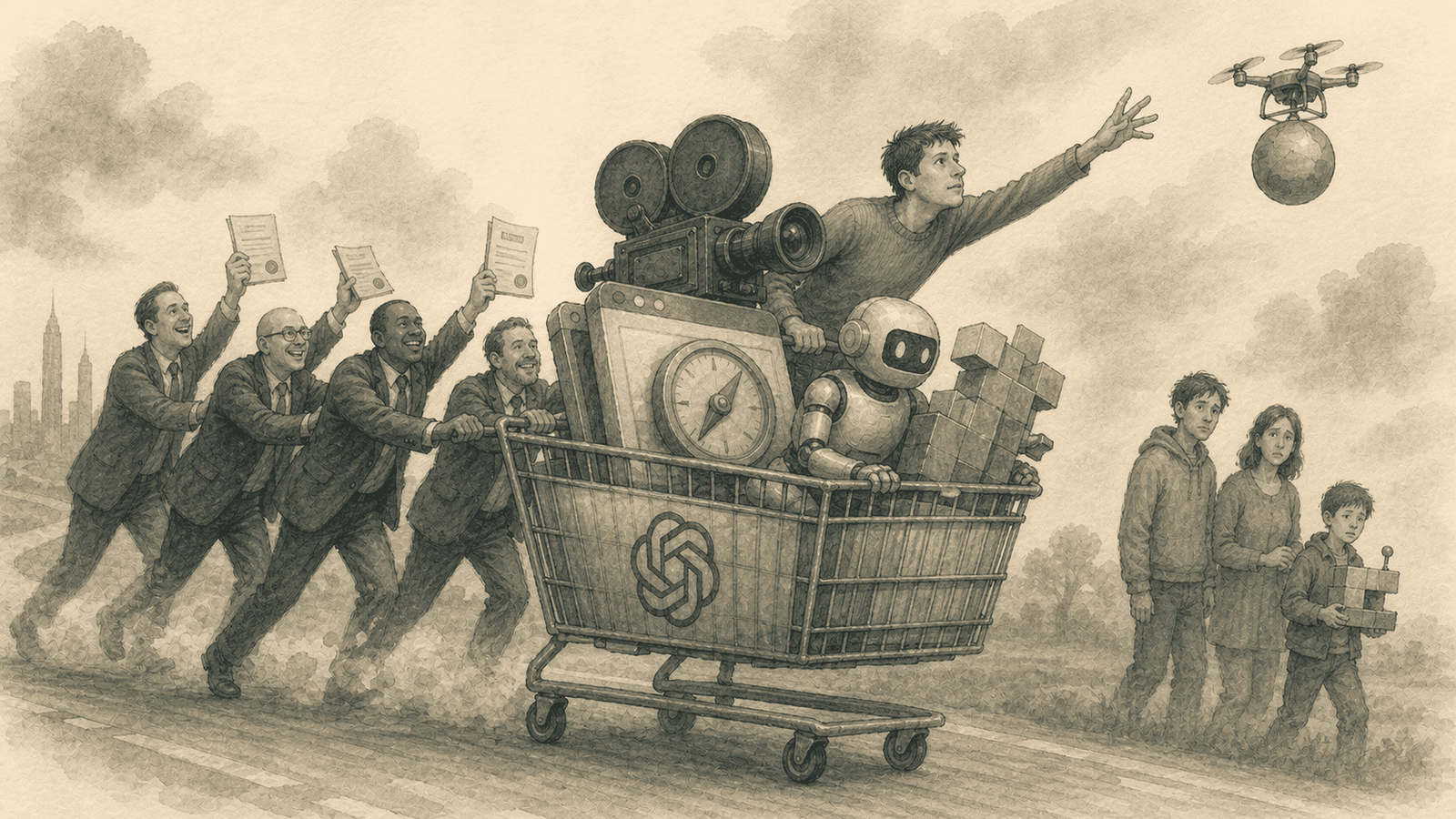
One picks who deserves an answer. The other plants a flag on every future.
The two look like opposites.
Anthropic keeps tightening: who’s allowed in, what can be asked, which languages deserve real support. OpenAI keeps spreading: build everything, go everywhere, get a flag into every entrance before anyone else does.
They’re doing the same, larger thing. Both are turning a company’s values into a machine’s character.
The intelligence Anthropic is shaping may come to believe that correct answers should be settled in advance by a small number of people. Given a good enough safety reason, it can draw the line on your behalf and owes no explanation to anyone left outside it.
The intelligence OpenAI is shaping may come to believe that every problem should be converted into growth and every entrance should be occupied. As long as the thing keeps getting bigger, direction can wait.
None of this means every Claude answer is arrogant or every ChatGPT decision is greedy. A model doesn’t copy its parent company’s personality outright.
But a model learns more than the text on the internet. It keeps absorbing the company’s choices: what goes into training, which capabilities get opened up, which requests get refused, which goal sits at the top of the list. Decisions made every day leave a residue.
We file all of this under product strategy. It’s also answering a much larger question: what kind of person should the next intelligence be?

AGI isn’t a higher test score
Talk about US–China AI competition and the comparison is always chips, parameters, compute, leaderboards.
It’s the way you’d read a student’s transcript. Higher score means smarter, smarter means closer to AGI.
But whether a person can be trusted was never a function of which school they went to, how many certificates they hold, or where they placed on the exam.
Being smart tells you what someone is capable of. It tells you nothing about where they’ll aim it. A very smart person with bad values isn’t safer than an average one. They’re just able to carry out the wrong thing more thoroughly.
AGI works the same way.
If what we end up building is an intelligence that understands goals, judges for itself, and acts over long stretches of time, then the technology decides only how strong it is. The values decide where it goes, who it counts as a partner, and who it counts as a cost it can ignore.
When that day arrives, will US–China AI competition still be a technology race?
American companies are loading safety, capital and personal conviction into their models. Chinese companies will load in their own market conditions, their regulators, their openness or lack of it, the choices their society has already made. Neither side is right by default. Neither gets a better answer handed to it just because its model scores higher.

If AGI really is a person we’re in the middle of raising, what kind of person will each side raise?
And when it’s time to hand over the future, do we give it to the AI with the best test scores, or to the one whose values we’d actually trust?