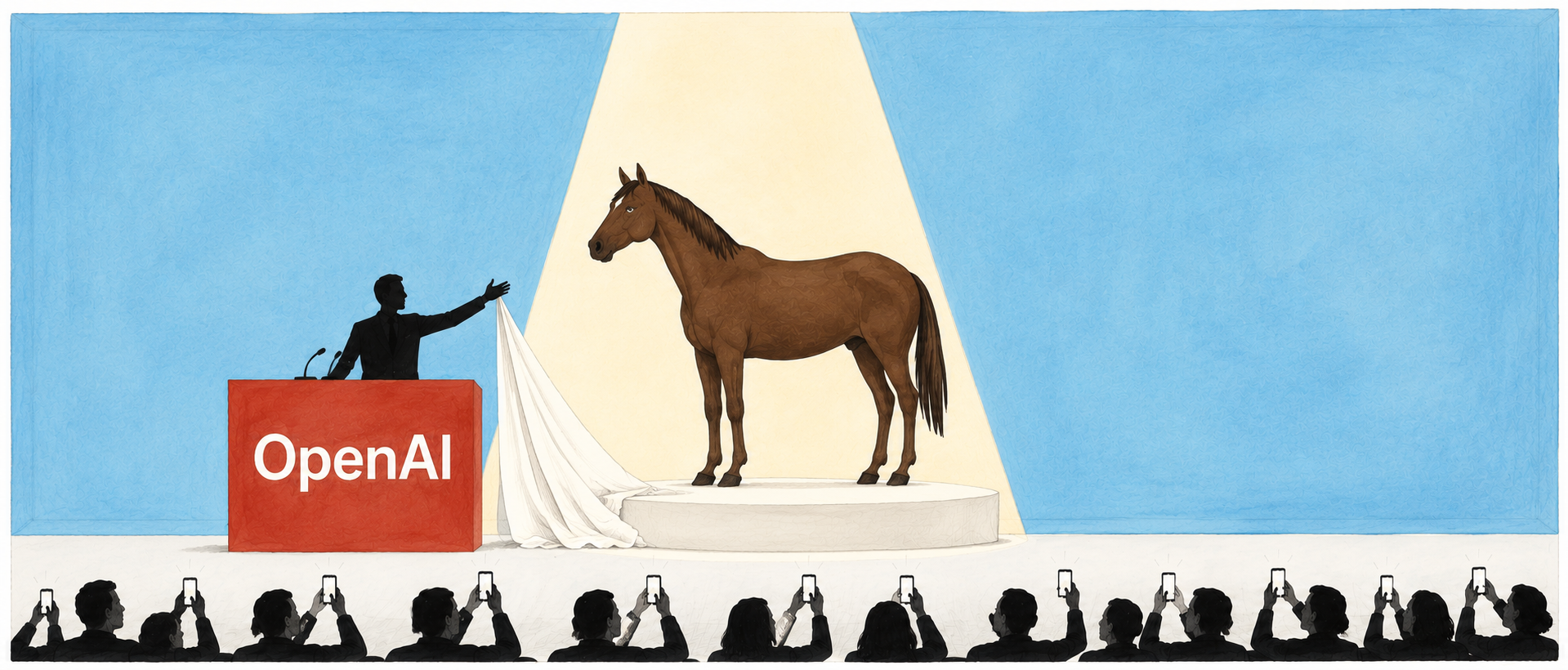
OpenAI let slip that it’s building an AI phone. Two tracks, actually. One is a small screenless thing about the size of an iPod Shuffle that you wear around your neck. The other is an actual smartphone, mass production in 2028, targeting three or four hundred million units a year.
So I went and read how the industry is talking about it.
Some say it’ll replace the apps on your phone with AI agents.
Some say it’ll “continuously understand your context” and get things done before you even open your mouth.
Some say it’ll be your “third core device” — computer, phone, and now this.
Altman says it’ll make you feel like you’ve returned to “the calm of a cabin in the mountains by a lake.” (Kind of poetic.)
The strange part is that almost everyone is telling the same story: a phone that’s smarter than a smartphone.
Why does everyone picture the same thing?
Look back at the products that actually defined an era. When they first appeared, almost nobody could picture their shape.
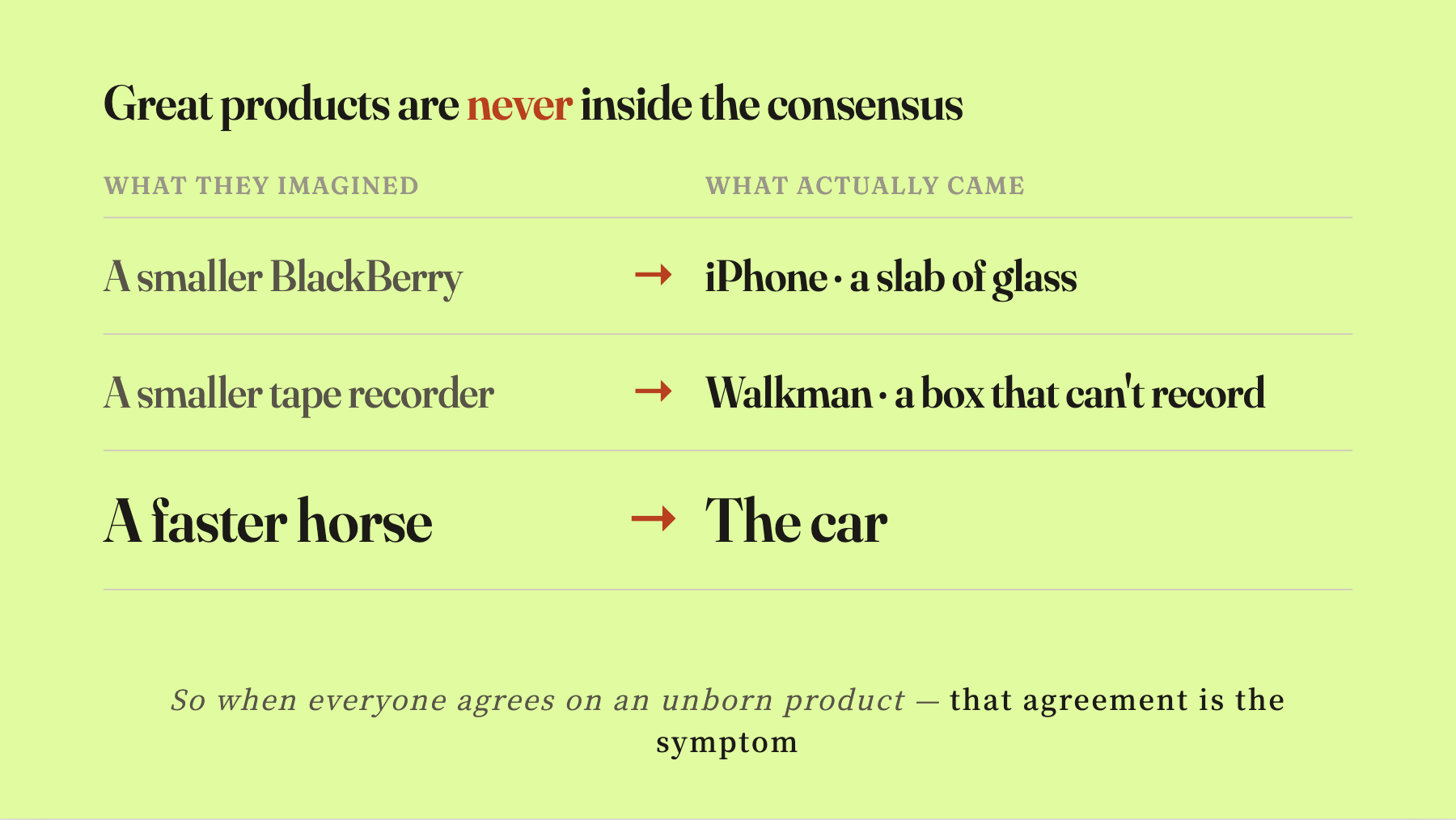
Before the iPhone, most people’s idea of “the future phone” was a BlackBerry with a smaller keyboard, or a Nokia with a bigger screen, or some mashup of an iPod and a phone. Nobody thought to throw out the entire keyboard and replace it with a slab of smooth glass.
Before the Walkman, everyone imagined a smaller tape recorder. The argument inside Sony came down to one question: who buys a portable player that can’t record? That little box that couldn’t record went on to sell hundreds of millions.
Great products live outside the consensus. There’s an old line that puts it brutally: if you’d asked people what they wanted before the car was invented, they’d have told you a faster horse.
Flip it around. When a product hasn’t been born yet and everyone agrees exactly what it’ll be, that agreement is a symptom. It means people are running an old set of mental grooves over something that doesn’t exist yet.
And every current vision of the AI phone comes down to one sentence —
“I want a smartphone that’s smarter than a smartphone.”
That’s the faster horse.
Apple told this exact story ten years ago
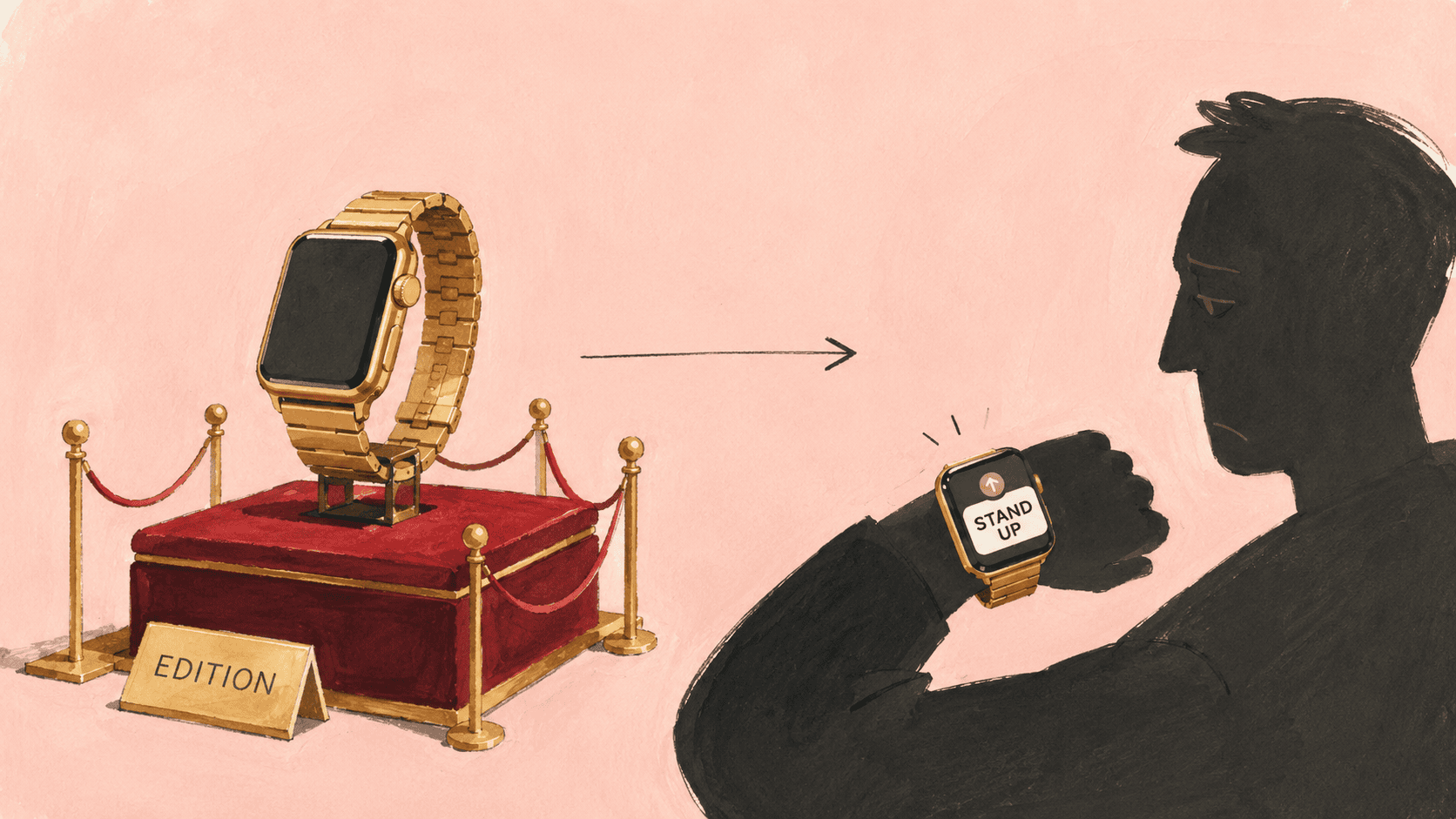
The Apple Watch shipped in 2015. It was also called the “third core device.” Cook said almost word-for-word what Altman is saying now: the first Mac, the first iPhone, the first Watch — Apple’s three pillars.
Before the launch, Apple laid down a heavy luxury setup. It hired Burberry’s CEO to run a new business. The first Watch came in a gold Edition priced at eighteen thousand dollars, sitting in boutiques in Paris, Tokyo, and London next to Hermès.
Ten years on, the Apple Watch has shrunk down to health tracking, workout stats, and fall detection.
That isn’t what Cook wanted. It’s what the product fell back to once it failed to become anyone’s third core — it retreated to a safe corner.
The luxury ambition came down to Hermès bands, sport models, the Ultra. A direction once meant to expand turned into scattered niche customization. Cook couldn’t grow the original idea, so once he found the idea was wrong and couldn’t easily walk it back, he kept shrinking it, inch by inch, into a small safe patch of ground.
What OpenAI is building now comes from the same mold as the Apple Watch.
Cook fell into this. Altman is falling now.
It’s too early to call Altman a failure. But this thing won’t ship until 2028, and from the way the story’s being told, it’ll probably trace the Watch’s curve — or worse.
Cook and Altman share one thing in how they start a product: neither one starts from the product itself.
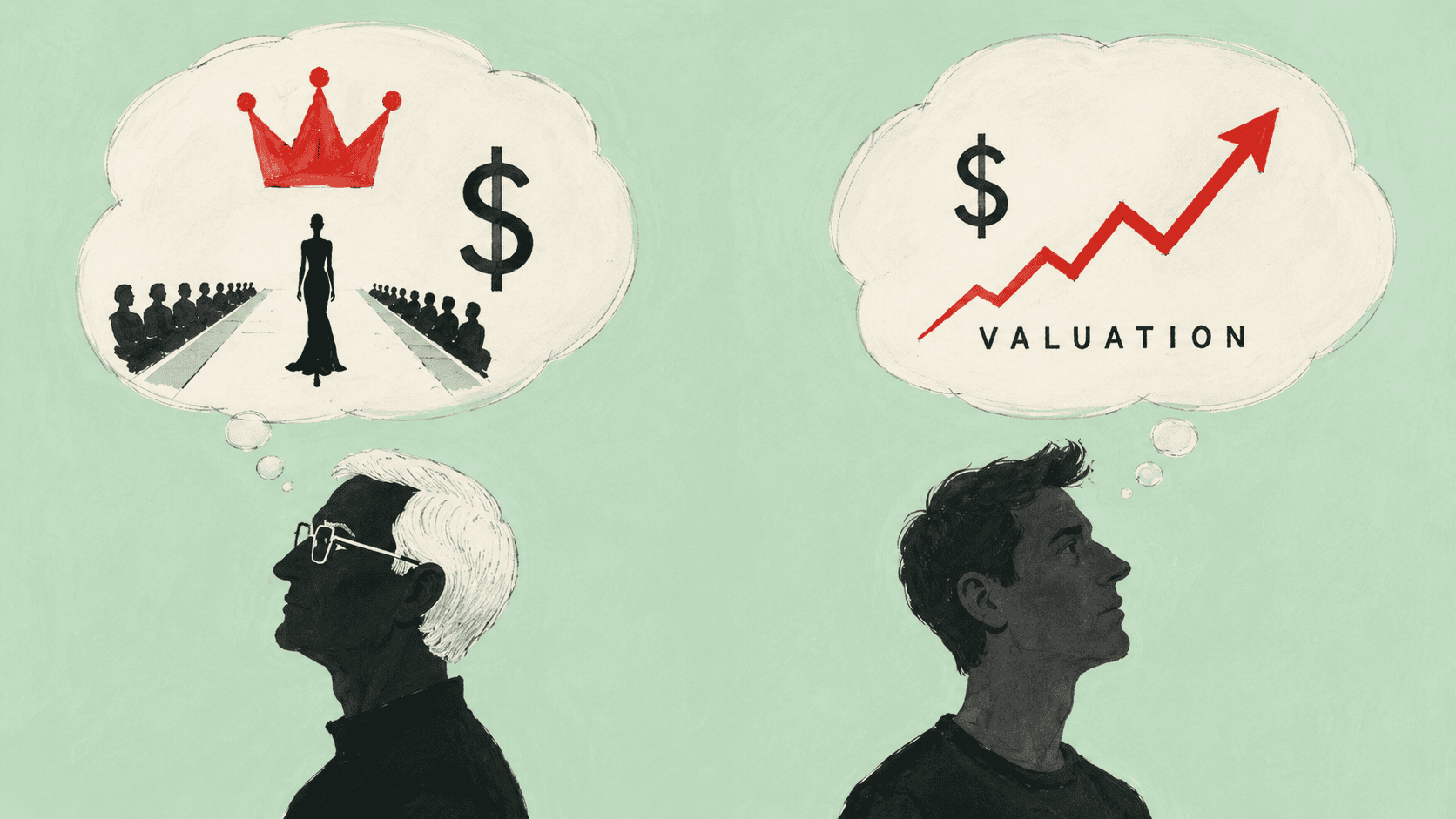
When Cook built the Apple Watch, the starting point was an image of identity. He wanted Apple to be a player in fashion. The Edition, the Burberry CEO — those weren’t product decisions, they were identity decisions. Then he worked backward: what kind of product would hold up that identity? That’s where the not-quite-right first Watch came from.
When Altman builds this AI hardware, the starting point is a different fantasy: a story that lifts a valuation. “Third core device,” “a hundred million units a year,” “calmer, more at peace” — who those lines are really for goes unspoken. Then, working backward: what kind of product would cash that story? That’s where you get a piece of hardware nobody has thought through.
Both men made a promise outside the product first, then built the product to match the promise.
This pattern tracks with what a CEO is being pushed by. If what he watches every day is the capital markets, not what users actually say about the product in front of them, his odds of botching hardware go up sharply. Hardware is far less forgiving than software of promising a thing and delivering it years later. Software can tell a story and iterate at the same time. Hardware, once it ships, is what it is. You can’t patch it.
”Health assistant” isn’t a good landing spot either
There’s a deeper layer here: the spot the Apple Watch retreated to isn’t even a good place to land.
“Health assistant” sounds fine. But think about it — is health really what most people want, or is it a product manager’s picture of how people ought to live?
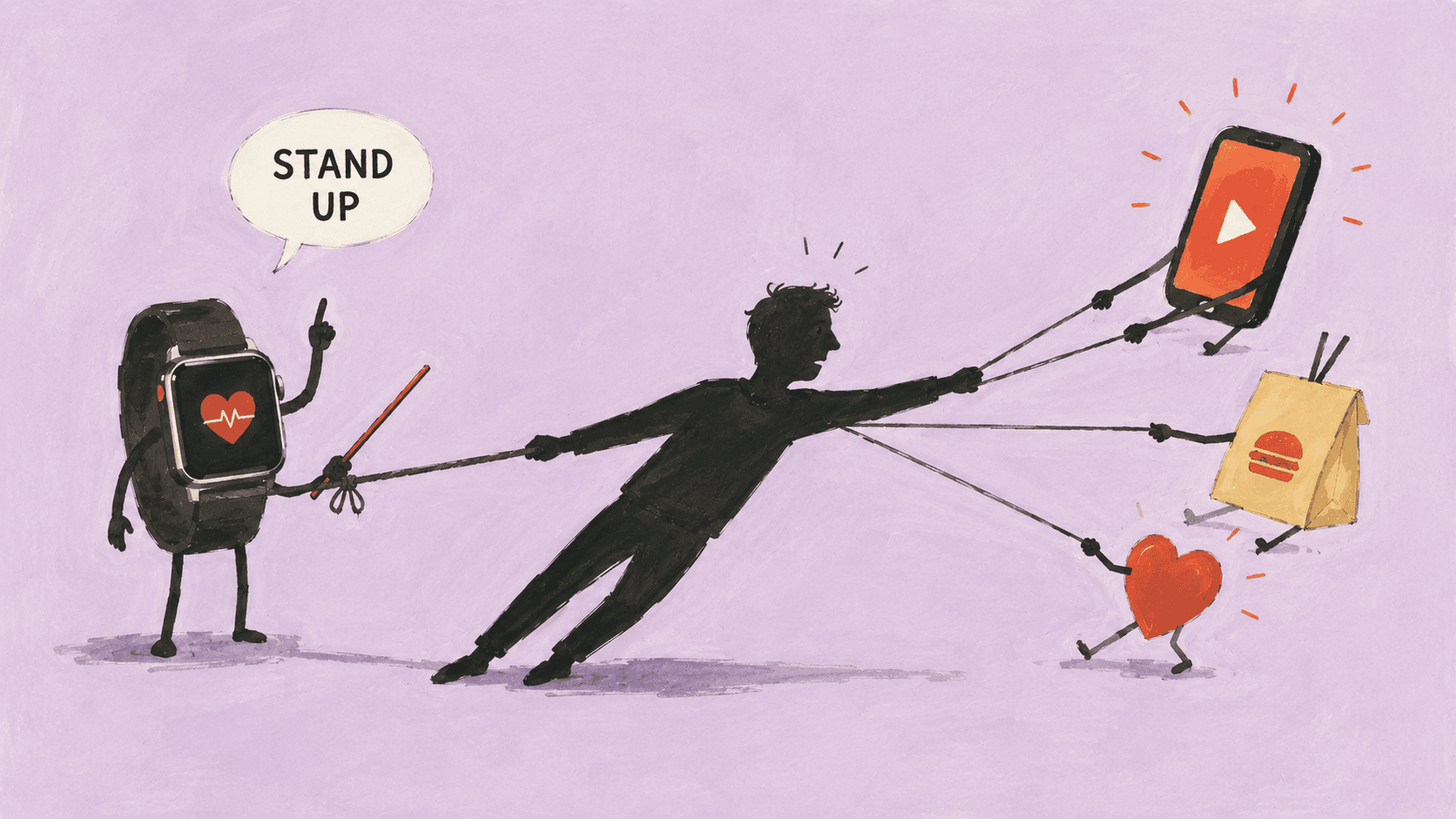
Almost every mass product that takes off serves some base physical drive. Short video is instant reward. Food delivery is hunger. Dating apps are mating anxiety. Nobody needs to be taught or talked into these. People are pulled along by want.
Health isn’t that. Health is something you have to be persuaded into, reminded about, nudged toward. The Apple Watch’s rings, its stand-up alerts, its breathing prompts — all of it is really saying: this is how you should live to be doing it “right.”
But look at the record. Products that set out to teach users how to live have basically never won.
People don’t like being taught. Learning runs against the grain. Getting a crowd to accept “you should live like this” is far harder than getting them to scroll for half an hour.
So the “health assistant” corner the Watch shrank into can only serve the small slice of people willing to manage themselves. It’s not where a mass product lands. It’s a safe corner you back into when you have no other choice.
The core tune OpenAI is playing for its AI device is this: let you understand your surroundings anytime, explore the world anytime, ask smarter questions anytime.
Sounds lovely, doesn’t it? But it’s the same kind of pitch. It assumes most people are wildly curious, eager to learn on their own, explore on their own, ask on their own.
I’ve fantasized about a pair of AI glasses myself — walk anywhere and they tell me what this is, what that is, what the menu says. Then I catch myself: am I mistaking the wants of people who like to learn for a universal human want?
A mistake designers make constantly is treating themselves as the user. But the user isn’t you.
So what should a real AI device look like?
What would an AI device that could actually hold up look like?
Follow the logic backward and you land somewhere uncomfortable: the first generation probably shouldn’t be new hardware at all.
It should start as a layer of software, dropped into the phones, computers, and earbuds people already own. Let it run. Watch which real, high-frequency behaviors AI actually changes. Once the behavior itself shifts, a new shape grows on its own out of what people are already doing.
That’s how the iPhone happened. Apple didn’t decide on a slab of glass first and then go looking for what to do with it. It saw what people were already doing — listening to music, browsing the web, texting, looking at photos — and then built a shape that could hold all of it.
OpenAI is doing the reverse. It fixed the shape first — one necklace, one phone — and is now hunting for what it does. That’s deciding the shape, then looking for a use, instead of letting the shape grow out of what people already do.
What makes it stranger: OpenAI is betting on two hardware lines with opposite strategies at once — a screenless, compute-less necklace, and a device that keeps the phone form factor. A company that actually knew what the product should be wouldn’t fund two contradictory hardware lines side by side. That alone tells you what they’re betting on isn’t a product. It’s a story.
And one thing that runs deeper than form
If AI really starts looking things up for you, thinking for you, deciding for you, then what it takes over isn’t just “how to do it.” It’s “what to want.”
Whoever decides what a device shows you and what it hides is deciding how a generation perceives reality.
There’s a lot inside that — more than a few essays could hold. I’ll leave it for another time.
Not the next iPhone. The next Apple Watch.
Back to OpenAI’s AI phone. Third core device, the calm of a cabin by a lake, a hundred million units. It’s a beautiful story.
But when everyone pictures an unborn device the same way, the device almost never turns out to be what they pictured.
OpenAI’s hardware probably won’t be the next iPhone. The likeliest outcome is the next Apple Watch — a loud entrance, then a quiet retreat into a corner held by a small handful of people.
Or worse. Not even as good as the Apple Watch.